On a grey, cold, misty but dry morning in January about 60 Friends arrived at The Savill Garden Visitors Centre to start the annual Winter Welly Walk.
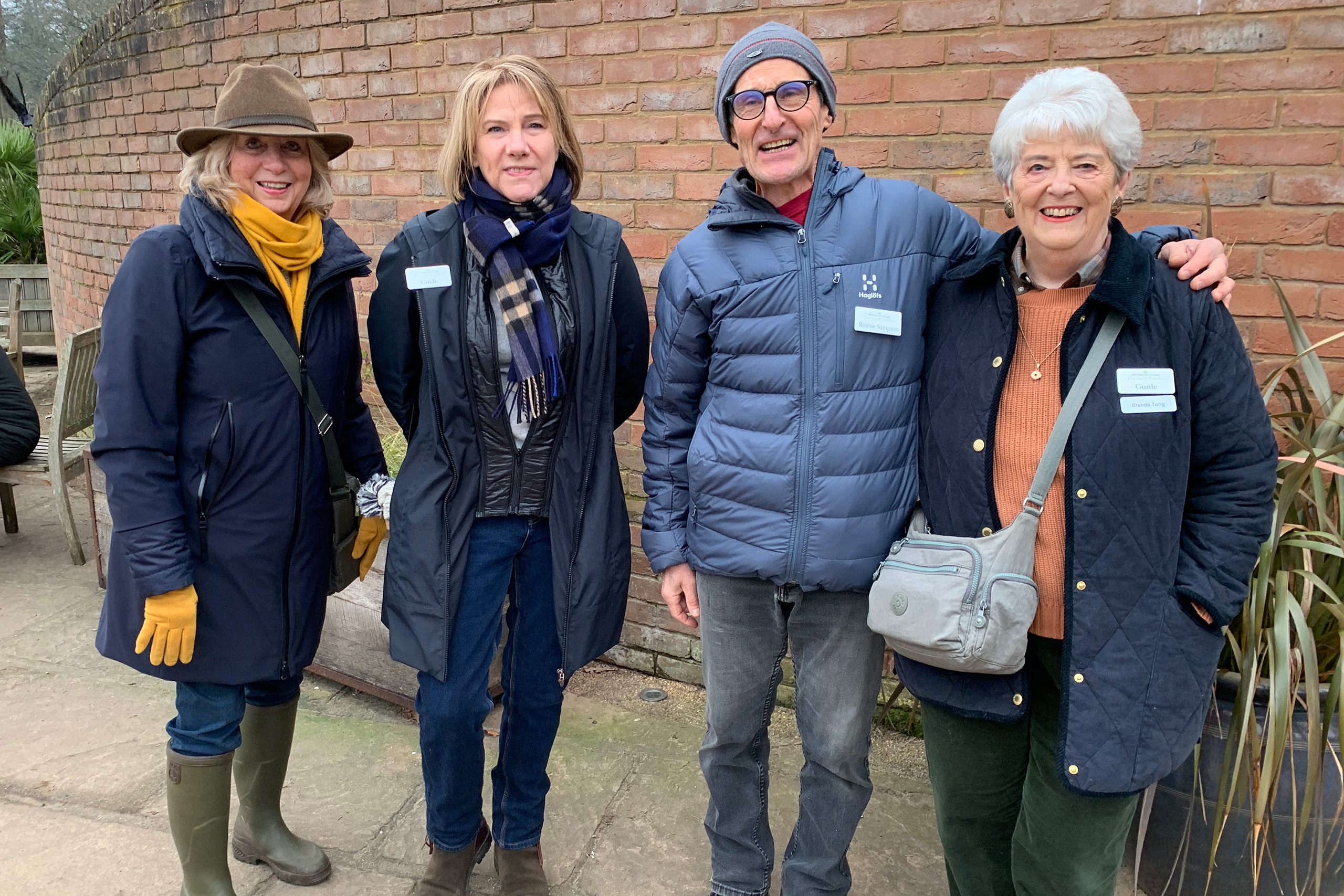
The Friends split into four groups and were led by the Friend Guides Liz, Sian, Robbie and Brenda. Sian and Robbie took their groups into Chapel Wood Arboretum for their walks while Liz and Brenda led the remaining two groups in The Savill Garden.
The Winter Beds
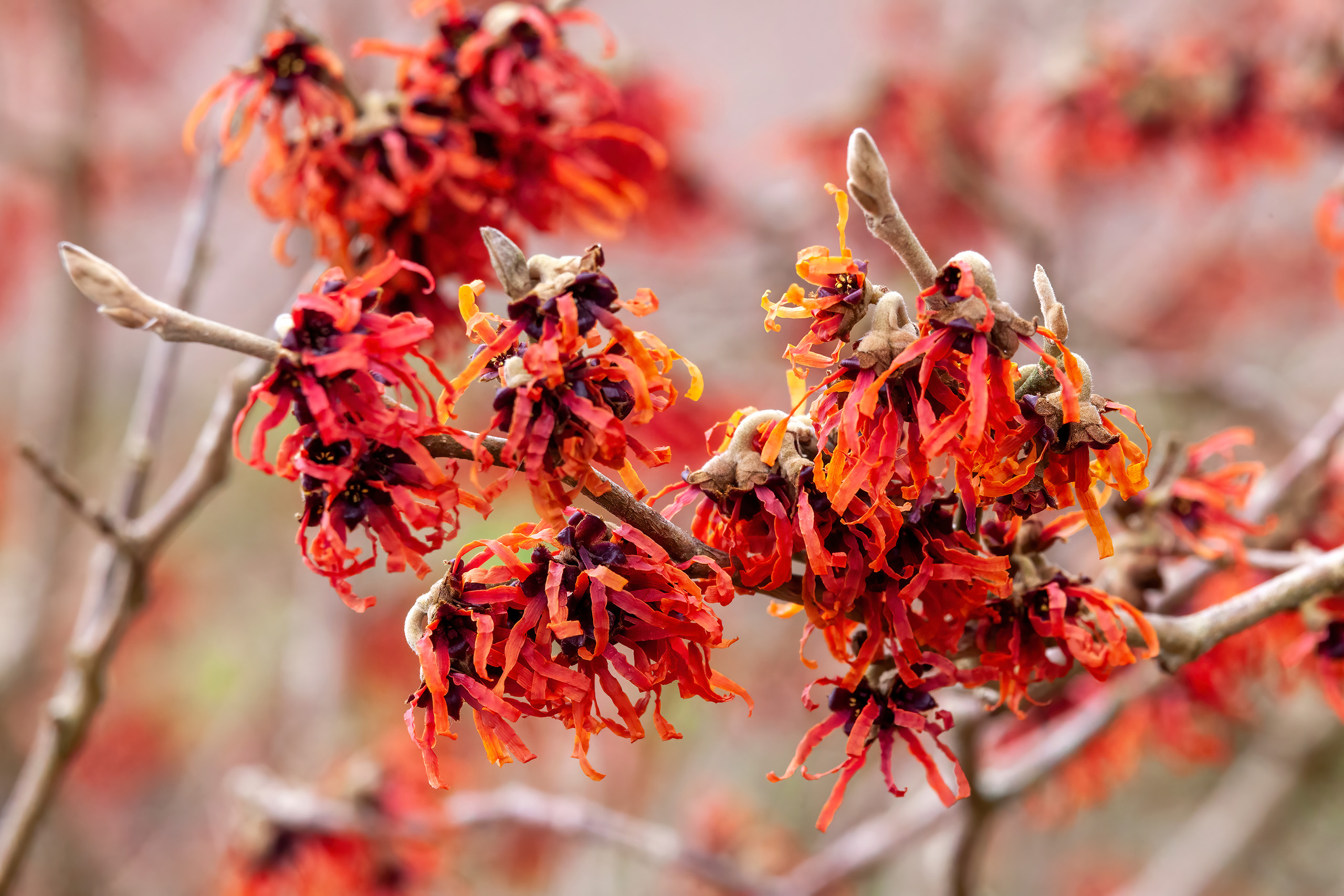
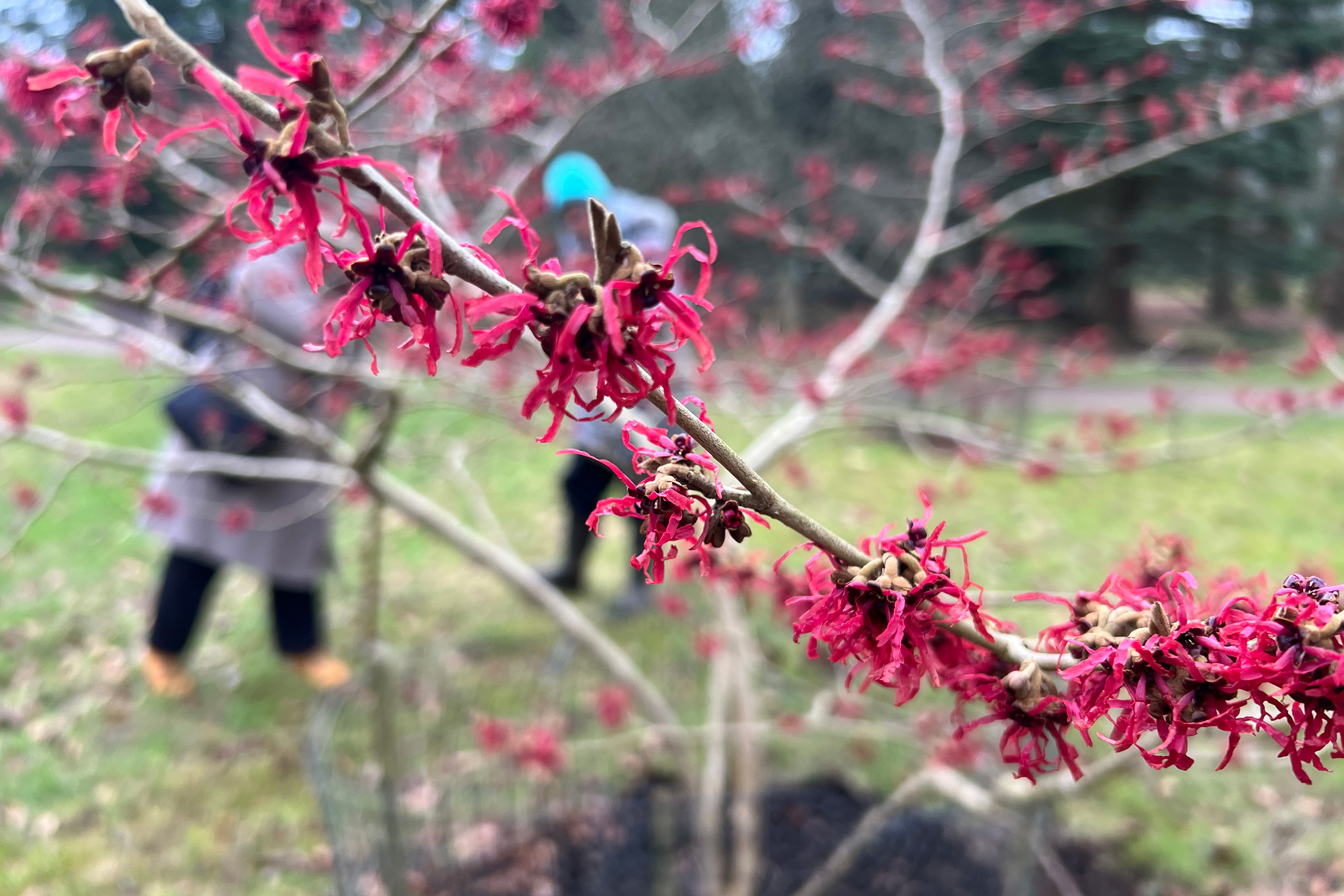
Liz’s group focused on three genera, Hamamelis (witch hazel), Helleborus and Mahonia. The group followed the path to the winter beds stopping to admire the Hamamelis x intermedia ‘Diane’ with its vivid red flowers. This variety was bred by Jelena de Belder and her husband, Robert, at Kalmthout, the family’s nursery in Belgium.
Throughout the walk, the group came across many other witch hazels, some of which are named after the De Belder family, including ‘Diane’, ‘Jelena’, and ‘Robert’.
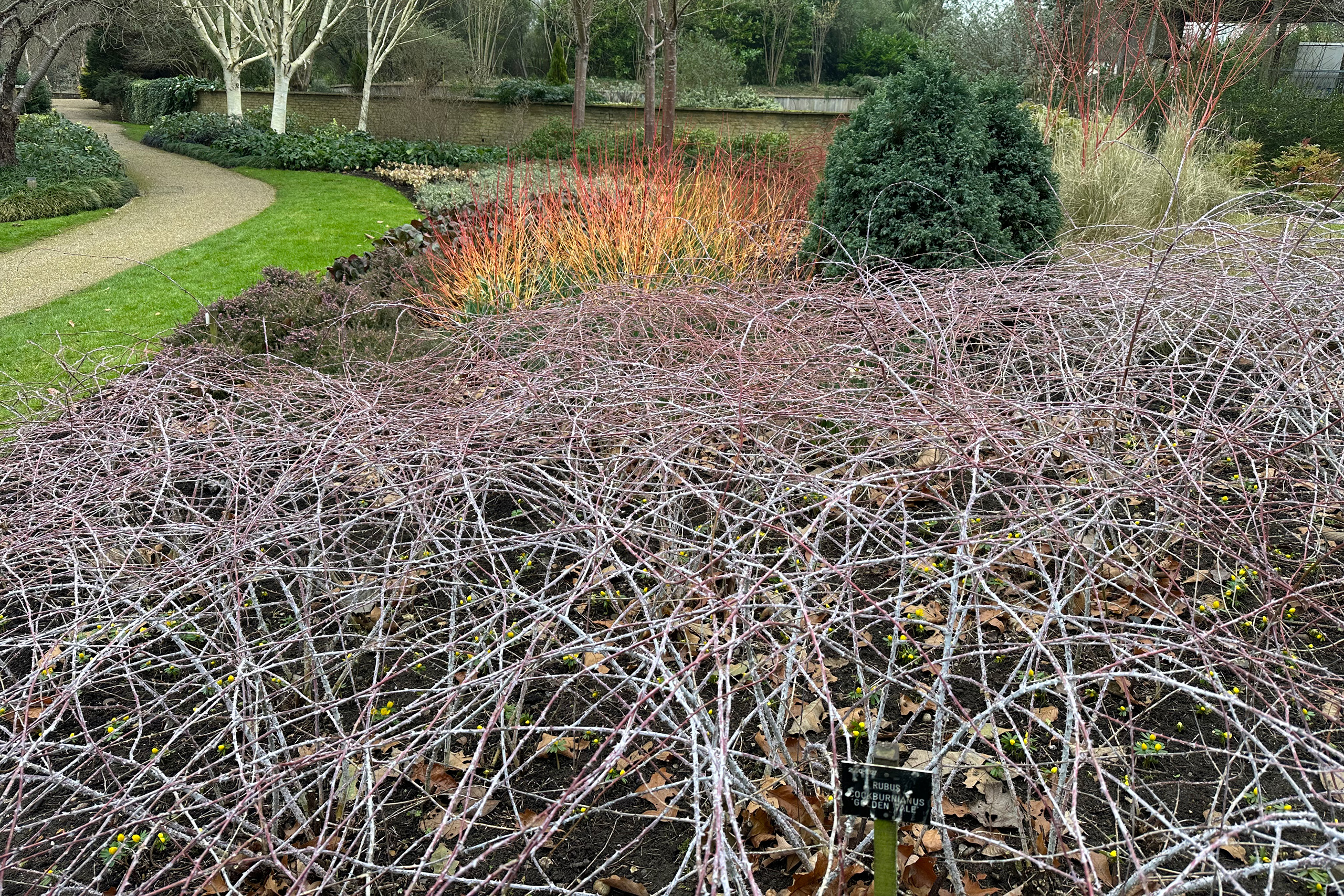
Another highlight in the winter beds were the yellow winter aconite under the silver arching branches of the Rubus cockburnianus ‘Golden Vale’. These had been planted when the Rubus was cut back in 2024.
Hamamelis x intermedia ‘Diane’
Rubus cockburnianus ‘Golden Vale’
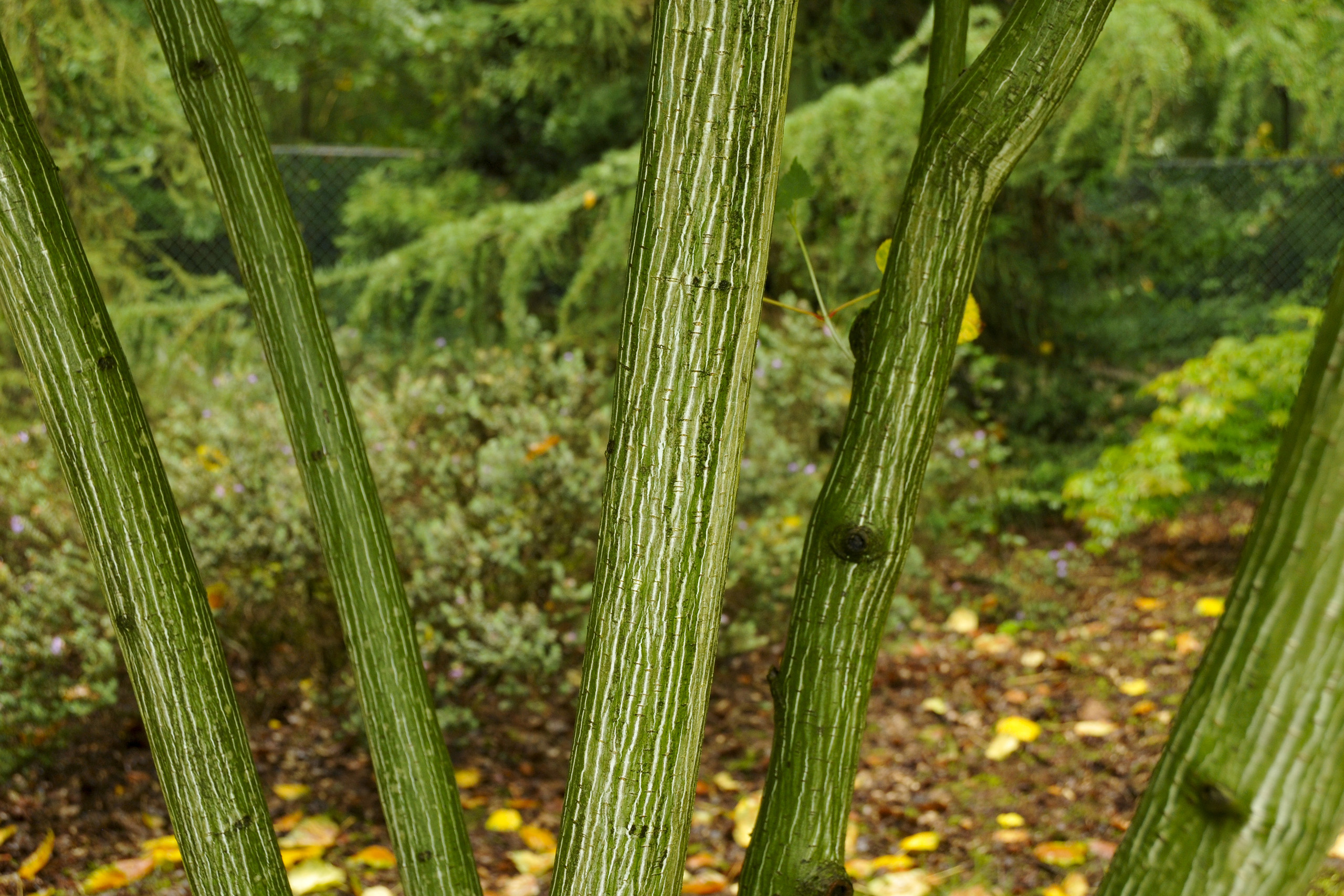
The group admired the striking many-coloured stems of the dogwoods (Cornus) and willows (Salix) and the stunning silver and jade streaked stems of the pollarded Manchurian maple (Acer tegmentosum ‘Valley Phantom’).
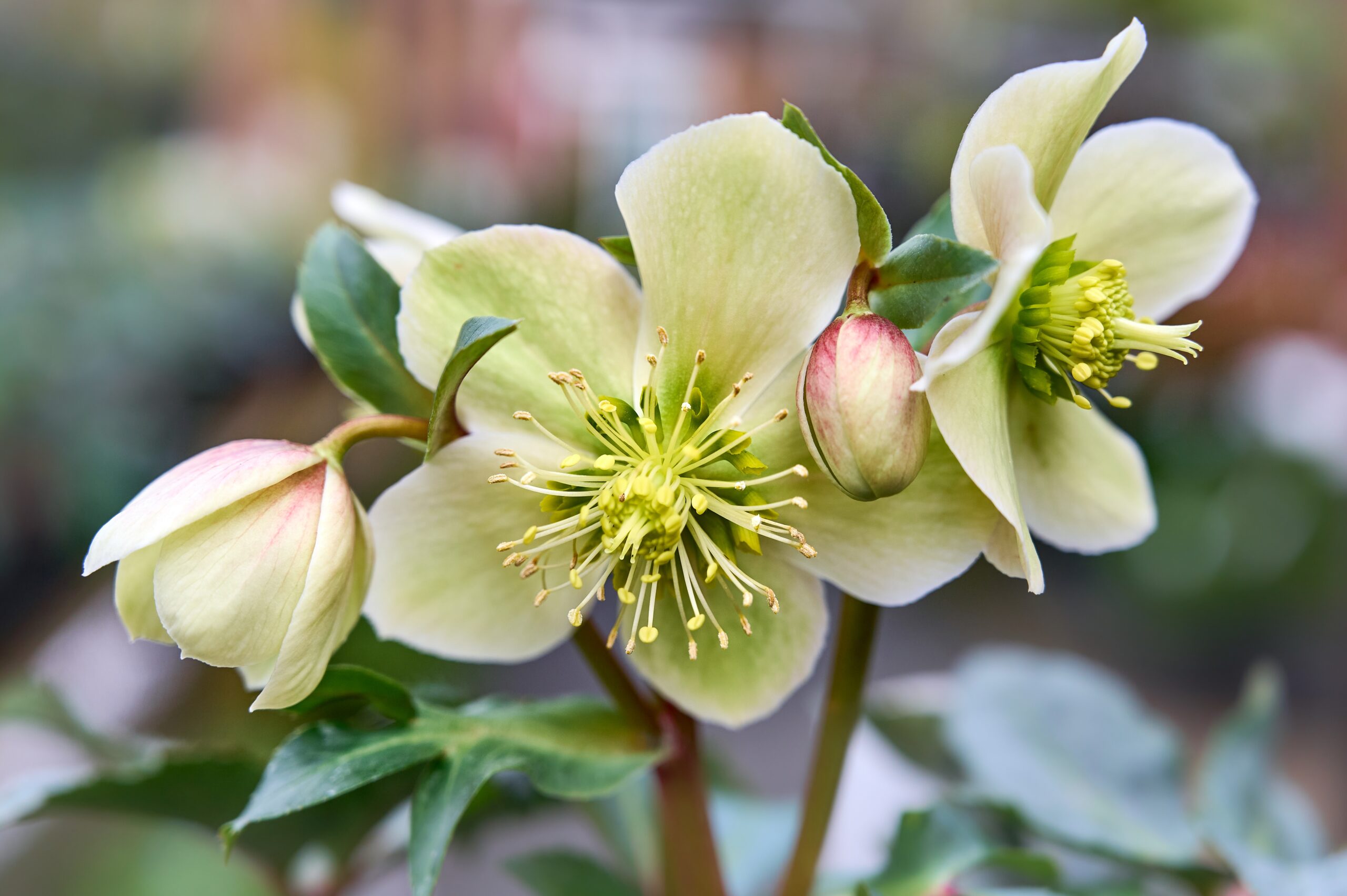
They then moved on to view the many different hellebores in the winter beds. The Helleborus x ballardiae ‘Camelot’ was in full bloom, providing a mass of pink and cream flowers. This then brought on a discussion of the range of different varieties, from the tall architectural leaves of the holly-leaved H. Angustifolia; the Christmas-flowering Helleborus niger and its hybrids, to the later-flowering ‘Lenten Rose’, Helleborus orientalis.
For more information about the hellebores in The Savill Garden, you can find more information in this article written in winter 2024.
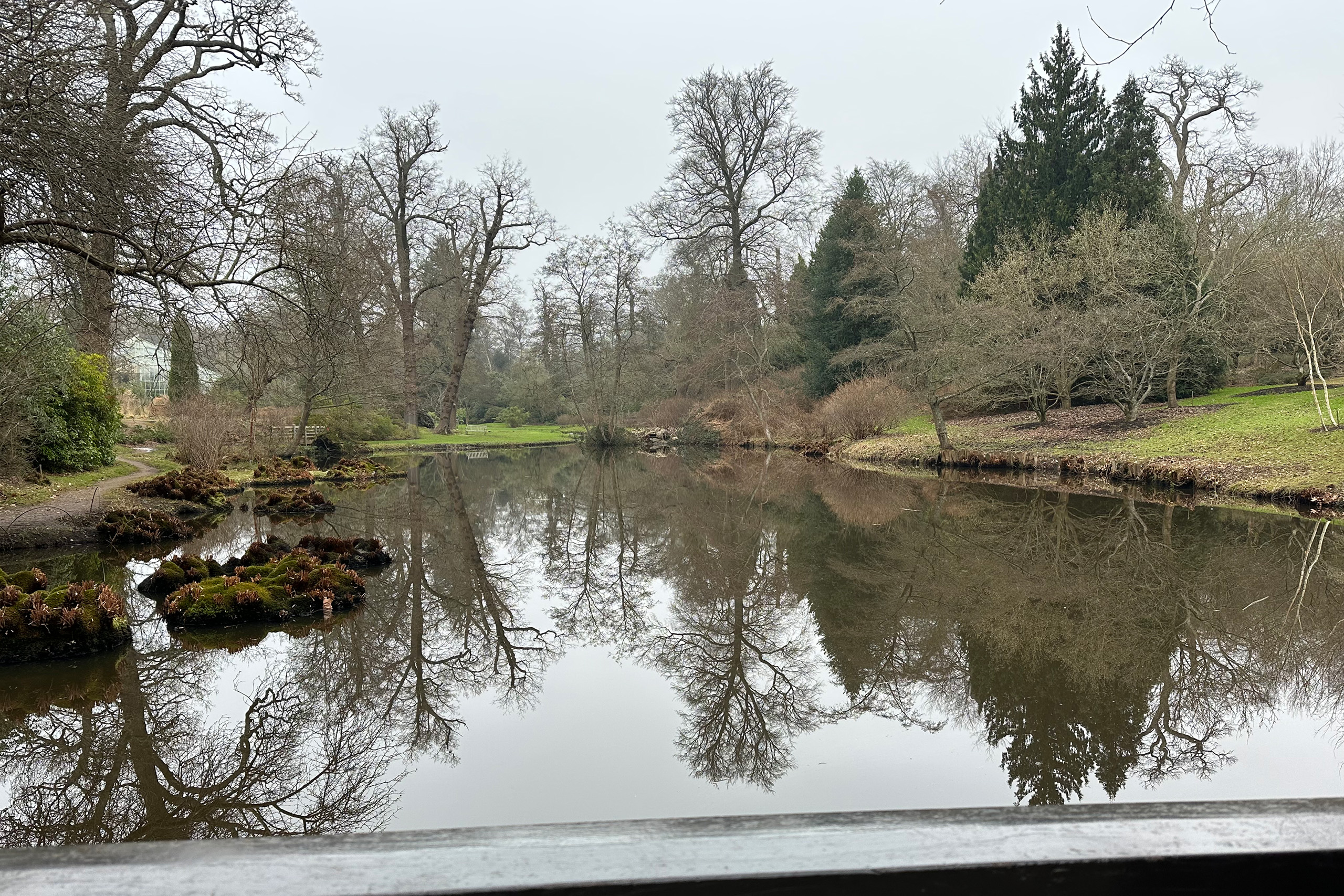
Middle Bridge
On reaching the bridge, the group heard that most of the carp have been removed from the top and bottom ponds and have been re-homed in fishing lakes in the Midlands.
The ponds will be drained to allow dredging to occur for the removal of 5-6ft /182cm of silt; the first time since the 1930s.
This will also allow the experts to make a new blue print drawing of Casson Bridge as the original plans cannot be found, therefore making it possible to rebuild the bridge.
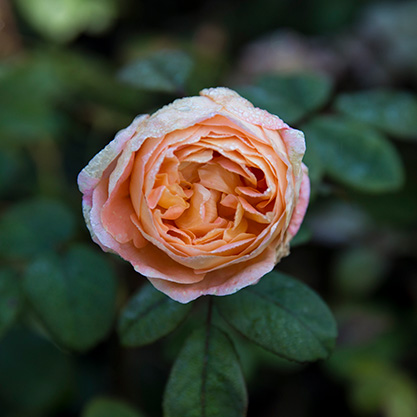
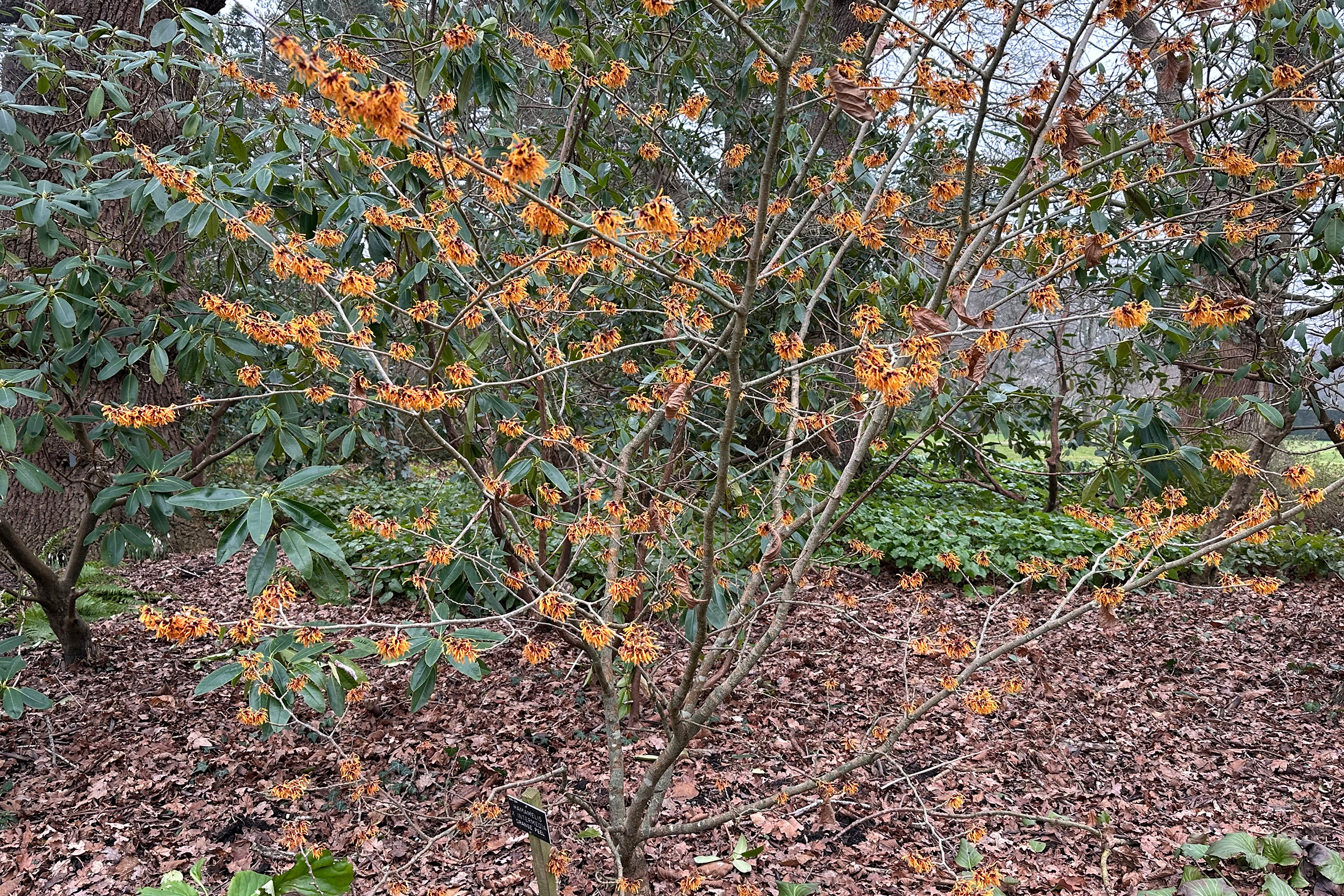
The tour then went along Middle Ride stopping to look at the hamamelis and hellebores. Two outstanding hamamelis were Hamamelis x intermedia ‘Orange Peel’ and Hamamelis x intermedia ‘Bernstein’. The group also stopped by the Parrotia persica (Persian Ironwood), which is also a member of the hamamelis family, and whose small red flowers were just beginning to open.
At the end of Middle Ride, the mahonias were in full flower, including Mahonia x media ‘Charity’, the original planting, named by Hope Finlay and Sir Eric Savill.
Hamamelis x intermedia ‘Orange Peel’
Spring Wood
We returned through Spring Wood, where recent work to open up the canopy has resulted in new planting of hellebores. The early spring-flowering camelias provided a splash of pink to the garden, including the glorious long flowering Camelia japonica ‘Gloire de Nantes’.
It was a very informative walk showing the diversity of these three genera and the amazing colour in the Garden in winter.
Chapel Wood Arboretum
The other half of Friends went on a tour of Chapel Wood, beginning with a short history of the area.
Apparently Chapel Wood had been part of the lands granted to Captain John Byfield, a captain in Oliver Cromwell’s army, in around 1650. Captain Byfield had been the first owner of what is now known as Cumberland Lodge. Its grounds had extended as far as the Obelisk and Virginia Water.
When Captain Byfield’s wife was removed from the Estate following the restoration of the monarchy, the area became part of Windsor Great Park and the Lodge was used as the official residence of the Rangers of Windsor Great Park, beginning with Baptist May, Keeper of the Privy Purse to Charles II.
In more recent history, John Bond, a previous Keeper of the Gardens, used Chapel Wood for plants surplus to requirements in The Savill Garden and Virginia Water.
The planting
Robbie, one of the guides, led the group off the beaten path to a ring of fir trees, Thuja plicata, which were planted as protection for a grove of Magnolia kobus.
Friends were encouraged to crush a small frond of the fir tree which released a delightful smell of pineapples. These trees are native to the Northwestern United States and Canada, they can grow up to 200 feet and, because their trunks are so straight, are used for totem poles.
The group soon spotted the Hamamelis which were in full flower and delighted the Friends with varying shades from deep russets and reds to bright yellow. Not all are scented but those that were, perfumed the air with their delicate scent; a reminder that spring is not far away.
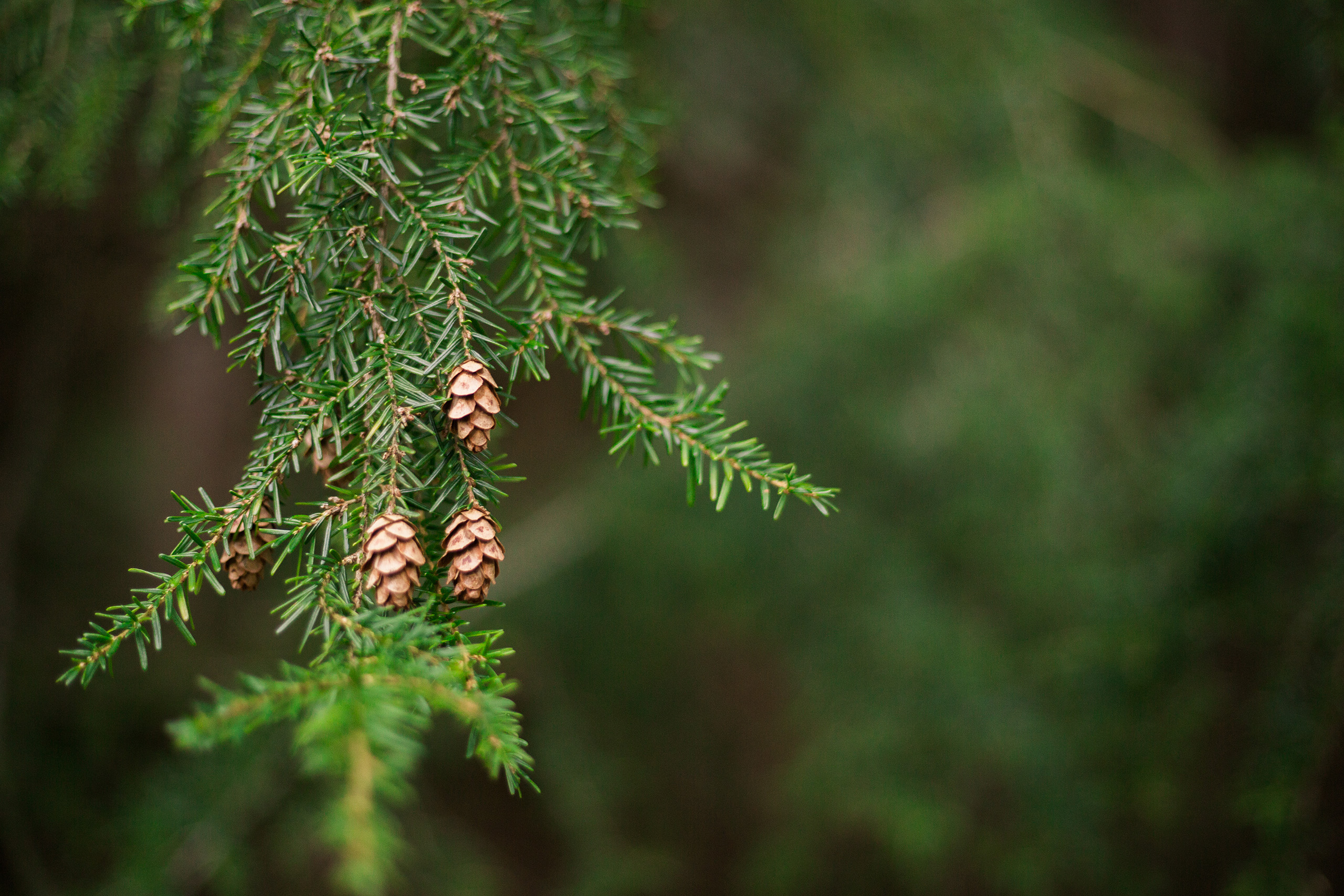
Not all trees were flowering and there was plenty to admire elsewhere. The hemlock was laden with tiny cones, and the group admired the bark of the Quercus suber, the Cork Oak and Quercus variabilis, the Chinese Cork Oak, with its gnarls and crevices. Robbie showed the Friends a tree which had been struck by lightning; there was a deep split in the bark straight down from the crown of the tree to its roots.
Hamamelis x intermedia ‘Livia’
Climate change
Robbie explained that Chapel Wood is also used as a testing ground. The open planting allows it to be a good indicator of the trees which will survive climate change and the conditions they need to survive and thrive. The group passed a large fallen elm; some new elms have been planted which it is to be hoped are resistant to the diseases which ravaged the UK’s native elms some years ago.
The Friends visited a grove of newly planted sequoia trees. It is amazing to realise that these little saplings, no taller than five feet or 152 cm, could eventually grow to rival the giant trees in the USA.
The walk took the group to Cow Pond where they saw a cormorant diving, as well as a number of moorhens and ducks braving the cold water.
Although Cow Pond is stated as being created in the 1700s, it is now believed to be much older, possibly as much as 1,000-years old. There are records which indicate it could have been a fishpond for Chertsey Abbey.
This account covers just two of the tours led by guides who volunteered to lead the walks. The Friends were very appreciative of all the guides involved and their detailed knowledge and enthusiasm. Despite the cold, everyone enjoyed the morning and thanks go to the guides Brenda, Liz, Robbie and Sian.