In his book ‘The English Flower Garden’ published in 1883, William Robinson, champion of the natural garden, wrote ‘Hellebores are the most effective, sturdy, impressive plants for opening the gardening year blooming abundantly from mid-winter to late Spring’.
The history of hellebores
There are more than twenty species of hellebore native to western Europe, the Balkans and China.
Hybridising of these began in Germany in the 19th century and gardeners ever since have worked to improve the plants. Today there may be as many as 900 different varieties.
The gardener and writer Vita Sackville-West said of hellebores ‘they will fill up many an odd corner, their demands are few and they give us flowers at a time of year when flowers are scarce’.
There are more than fifteen different Helleborus (the Latin name for hellebores) planted in The Savill Garden, and most do well because of the sandy, well-drained soil; humus rich from seasonal mulching. They can tolerate drought and dry soil with the addition of organic material. In the main they are planted in full sun with some in dappled shade.
They are a classic, elegant plant for winter interest with a long flowering period and beautiful, interesting foliage.
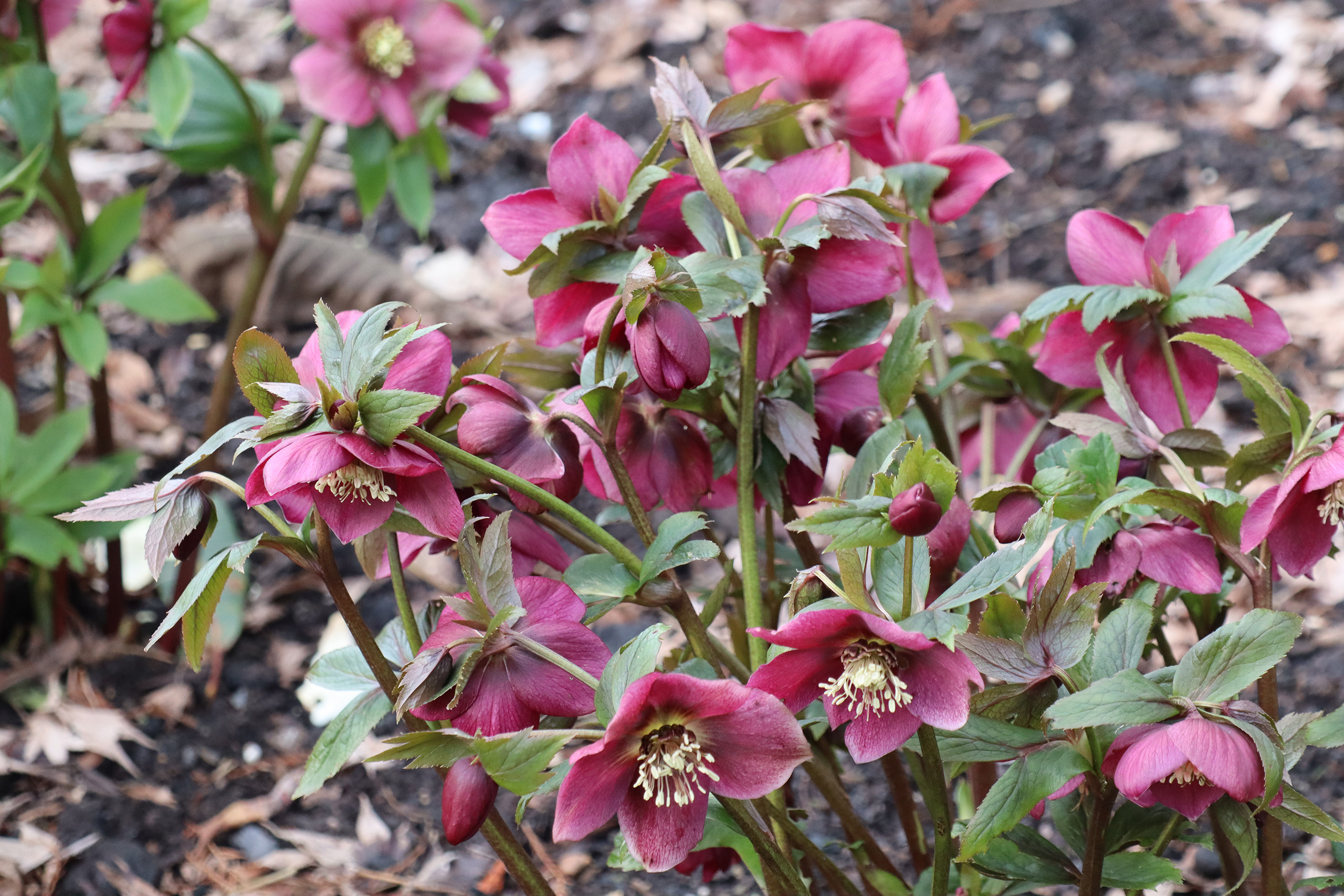
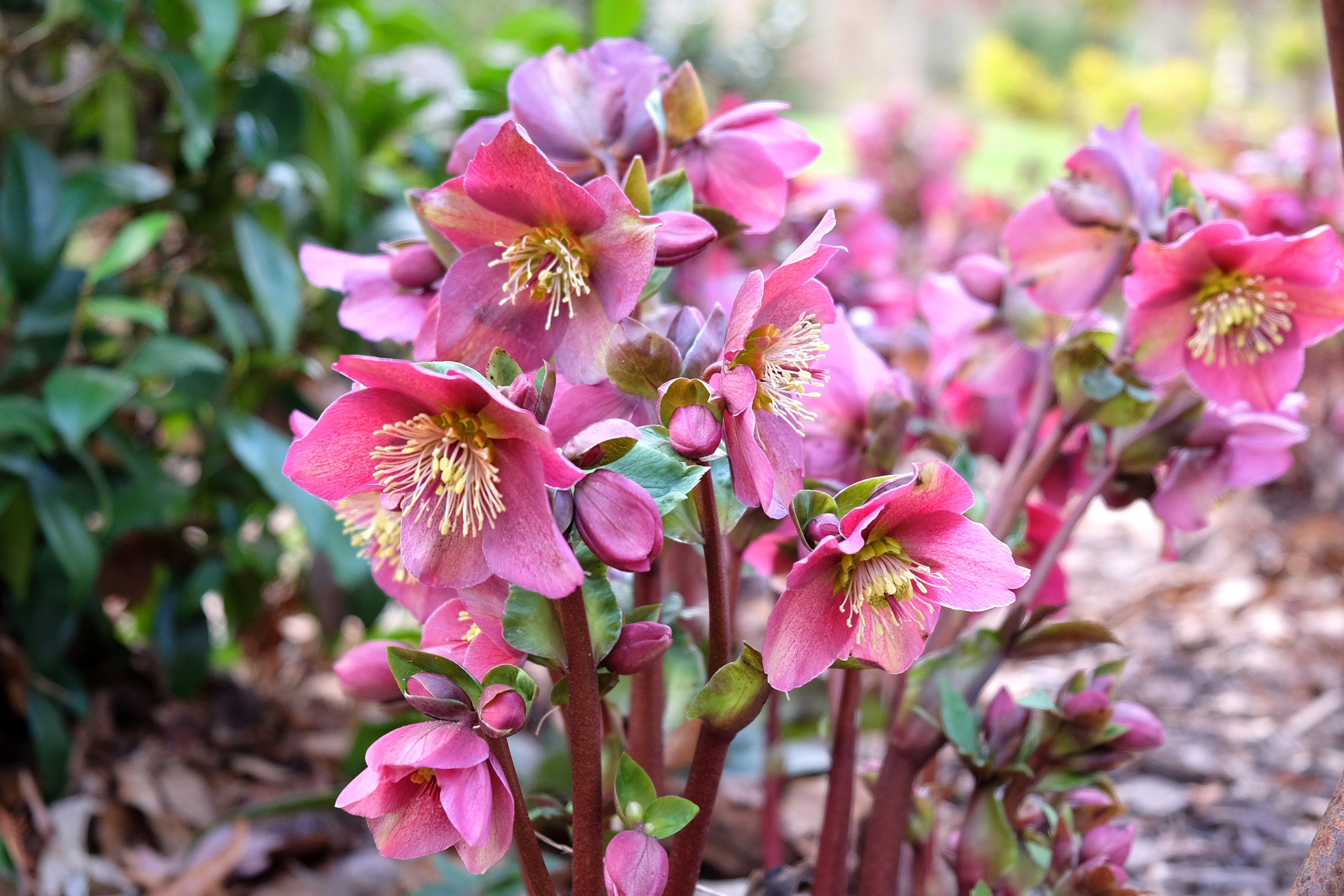
Pink hellebores growing in the Winter Beds of The Savill Garden
‘Hellebores are amongst my favourite plants because of the joyful variety of flowers they bring, during a time when they are most appreciated. The family they belong to, the Ranunculaceae (Buttercup family) is one which I seem to find myself gravitating towards as I love their simple flowers and variety of leaf type. The hellebore is a long-lived winter herbaceous perennial.’ Michelle Cleave Supervisor, The Savill Garden
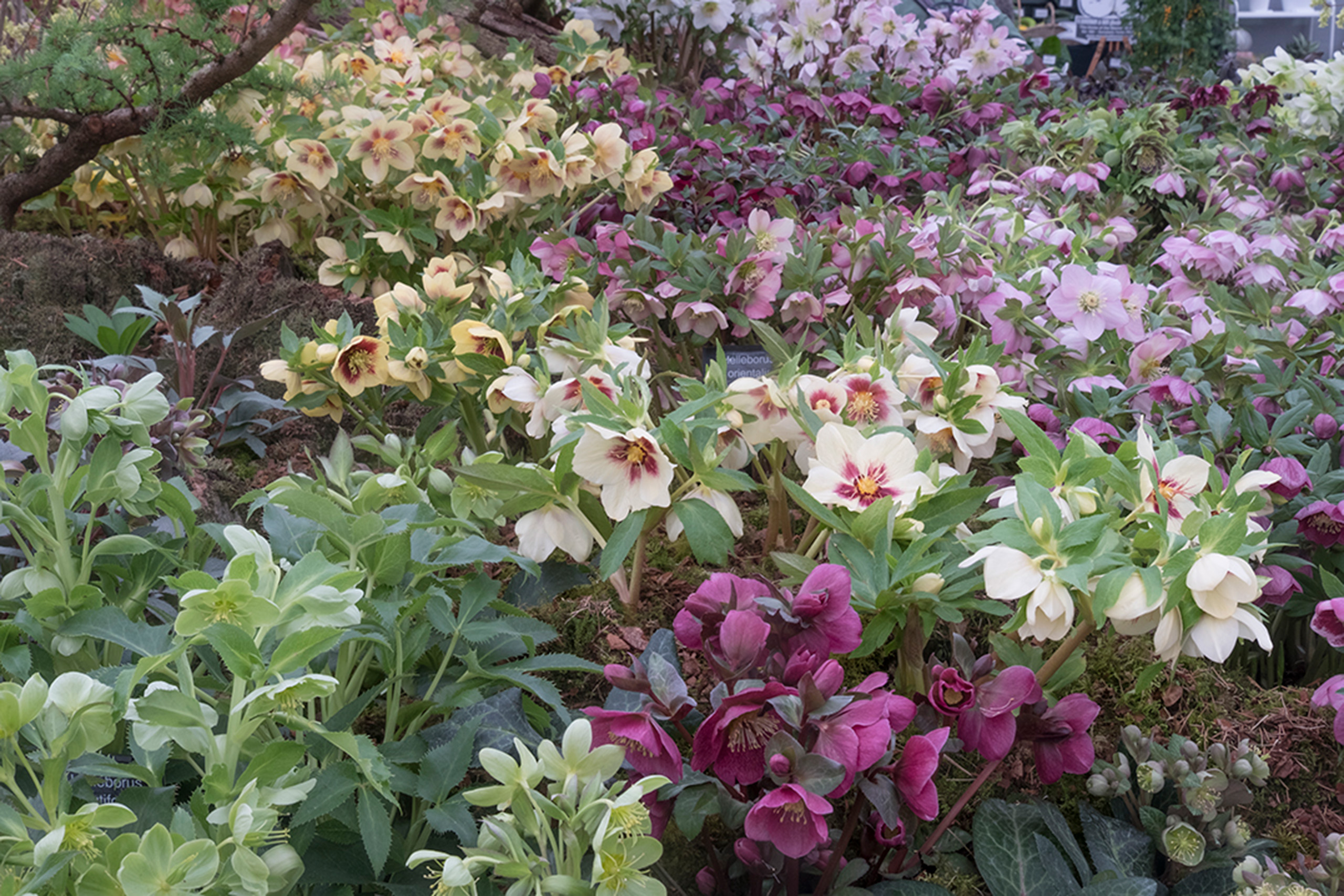
A well-established plant, they have grown in popularity over the last forty years because of the arrival of Helleborus x hybridus – (H. x hybridus) the botanical name given for a new group of plants – colourful hybrids of H. orientalis that have upright flowers, dark green foliage and colours ranging from pale cream pinks to yellows, deep plum and almost black.
Hellebores in Spring Wood
Records show that H. orientalis were the first hellebores to be planted in the Garden, in Spring Wood. Our woodland areas have natural leaf litter and are therefore the perfect place for them to thrive.
Most hybrids originate from the species H. orientalis which is native to the western Caucasus and Georgia and although mostly cream in colour, some coloured forms were introduced into Europe from Russia, and these have been extensively used by breeders.
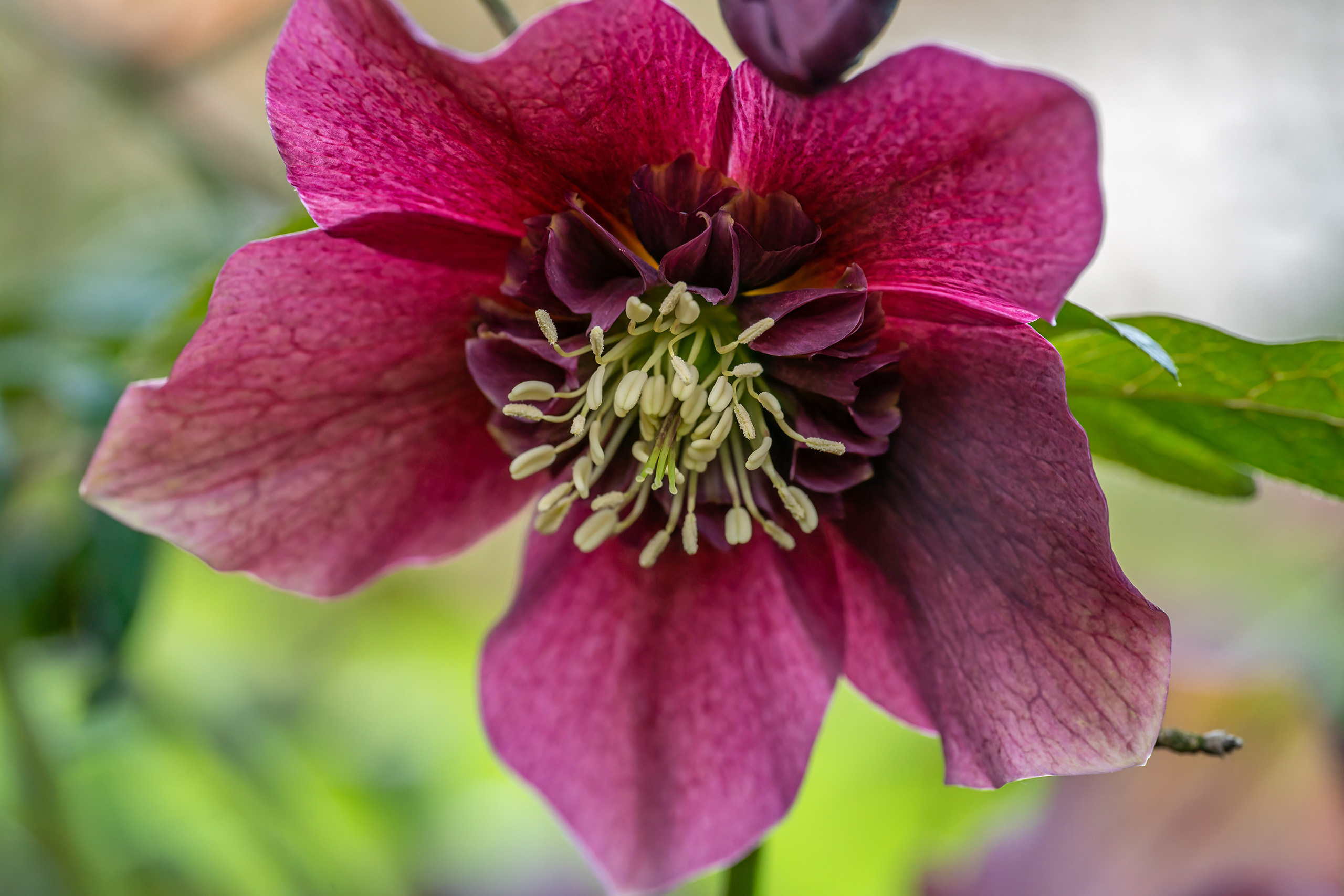
A red H. orientalis flower
Hellebores in the Winter Beds
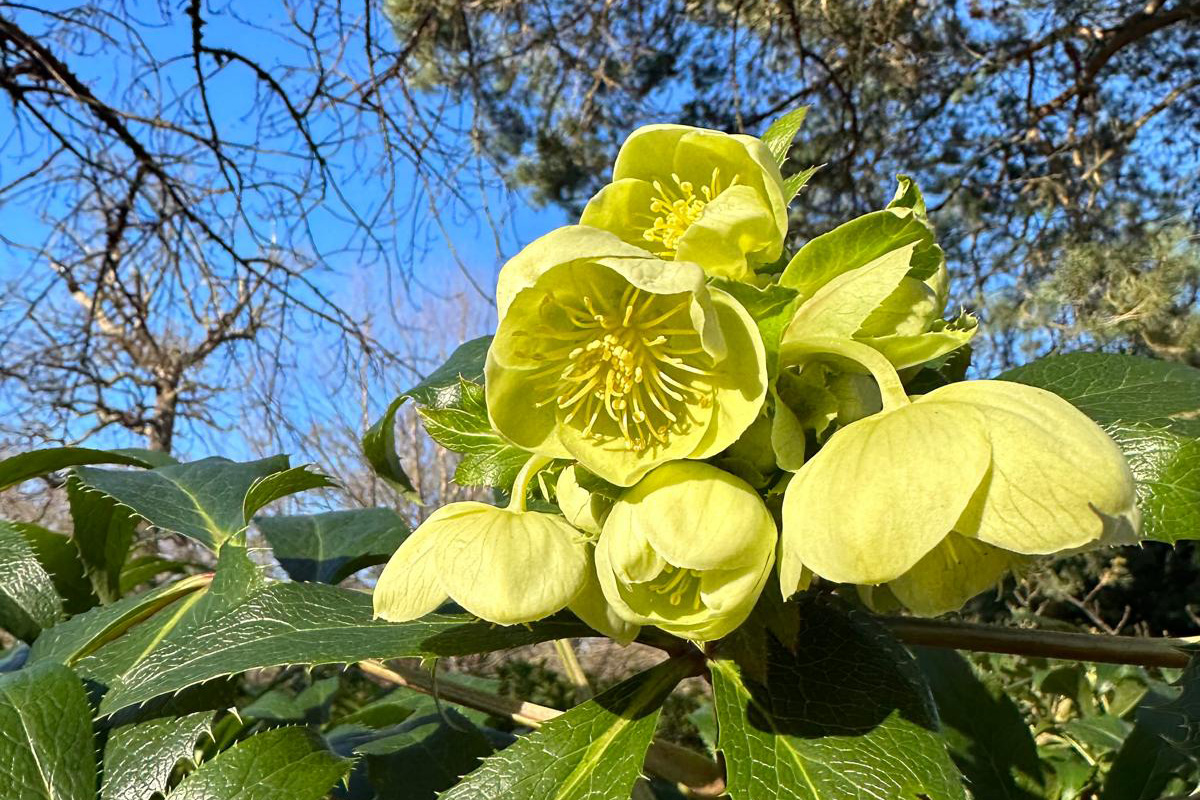
Other species and their cultivars in the Garden are H. argutifolius AGM (RHS Award of Garden Merit). This is a Corsican hellebore, growing underneath the Prunus rufa, in the Winter Beds.
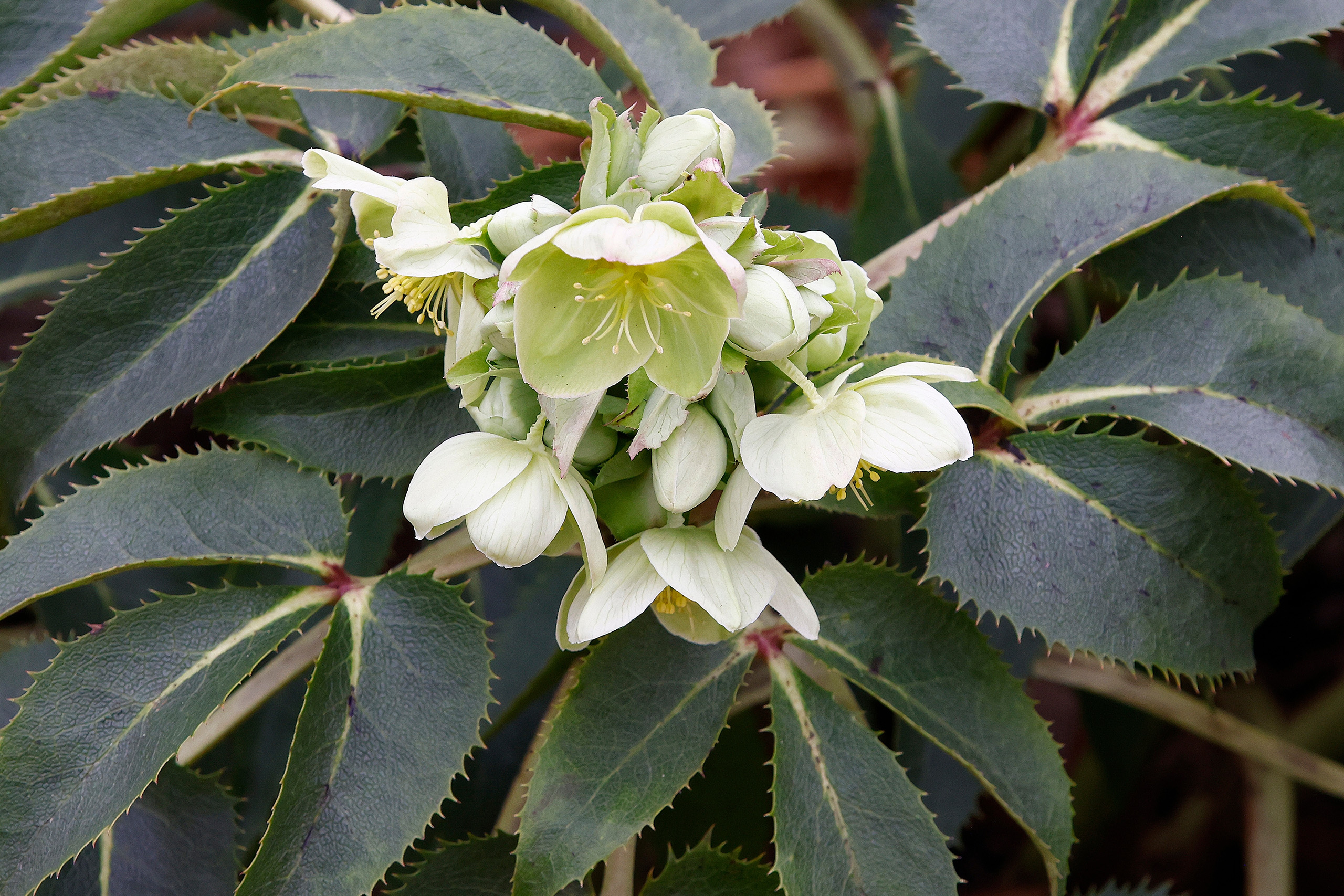
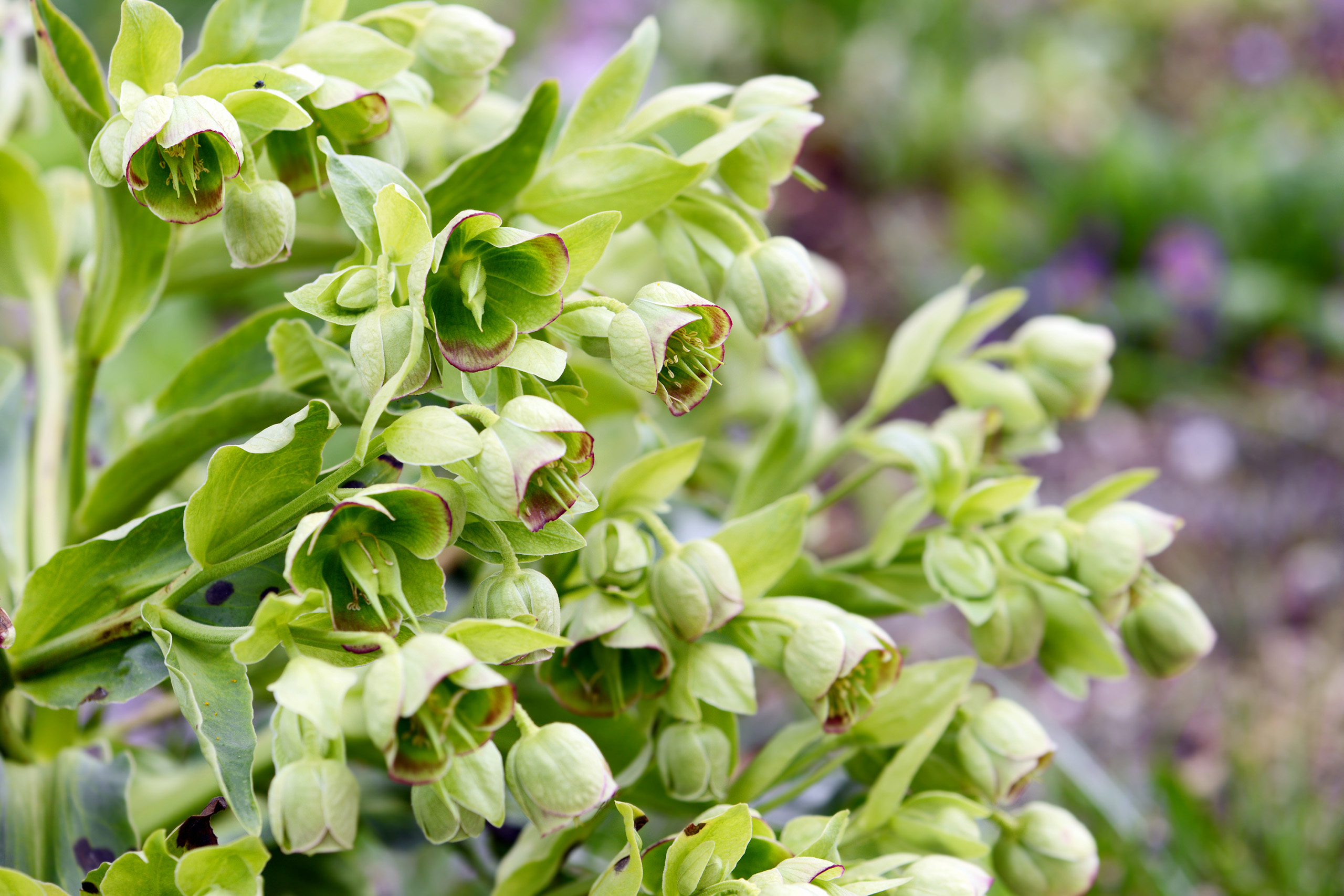
H. sternii ‘Blackthorn Stain’ grows near the Betula jacquemontii ‘Silver Shadow’ and is superb for winter interest with their wonderful architectural leaves and nodding bowl-shaped, creamy-green flowers. These are such useful plants too for our changing climate and they also work very well in flower arrangements.
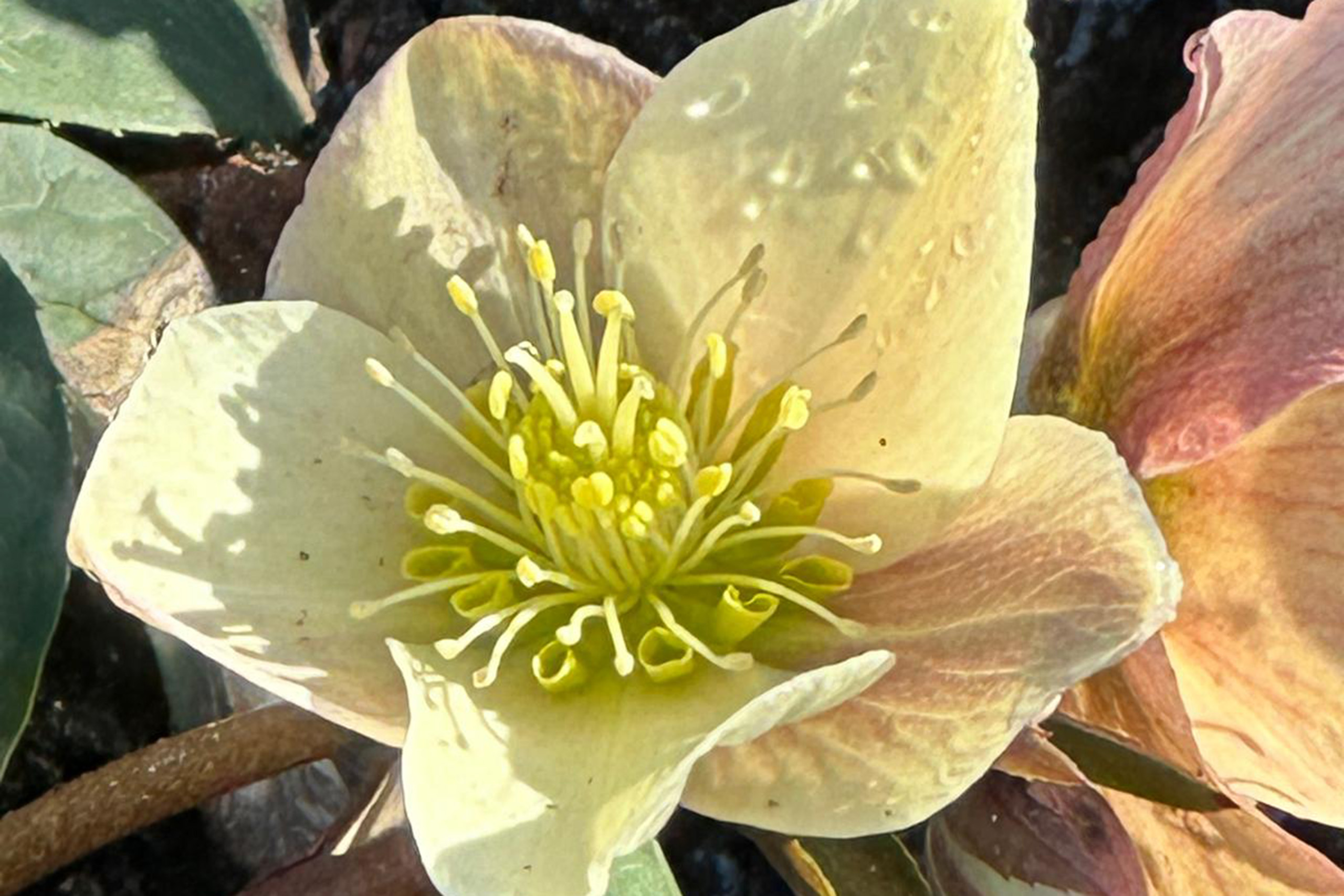
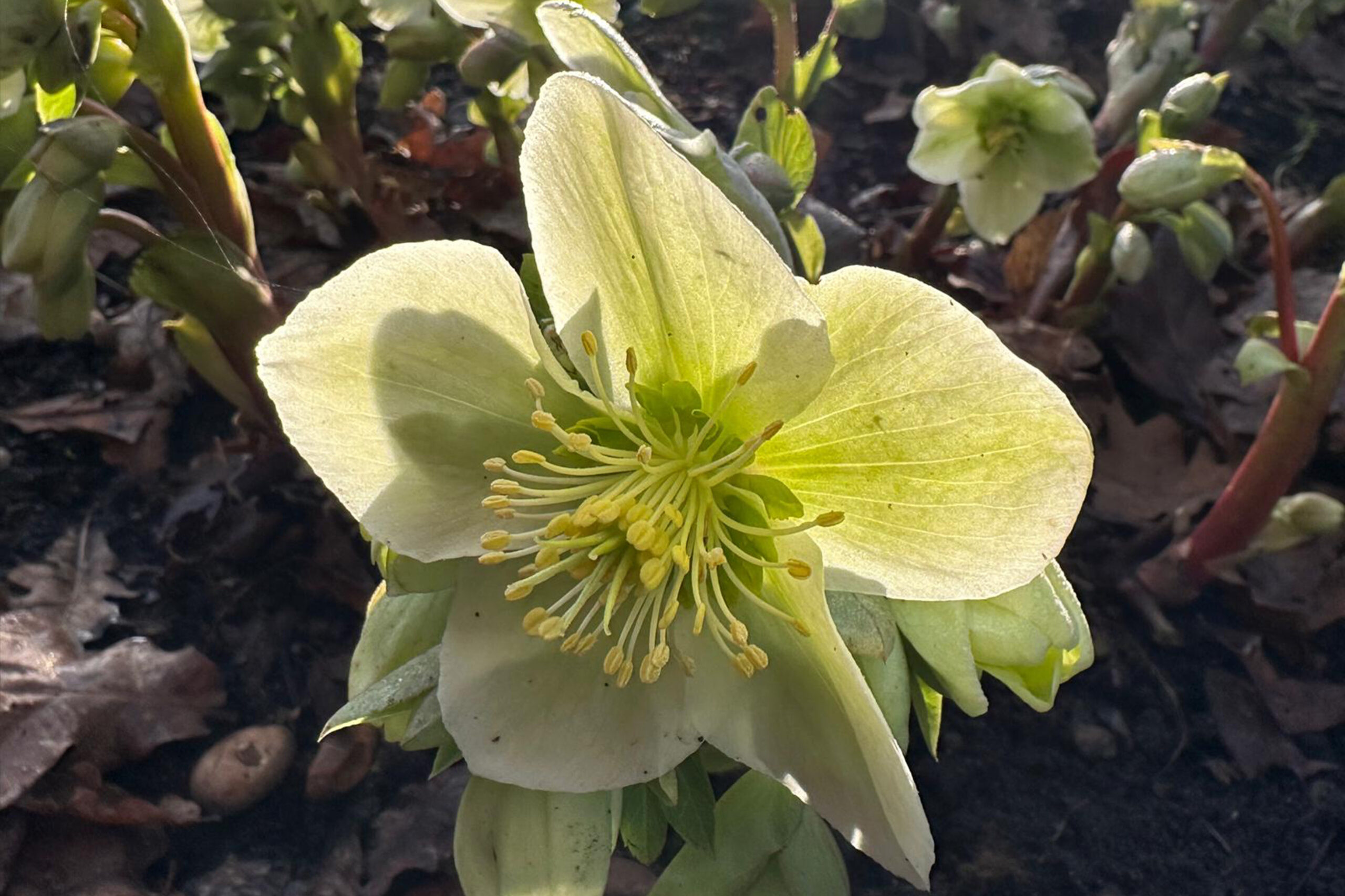
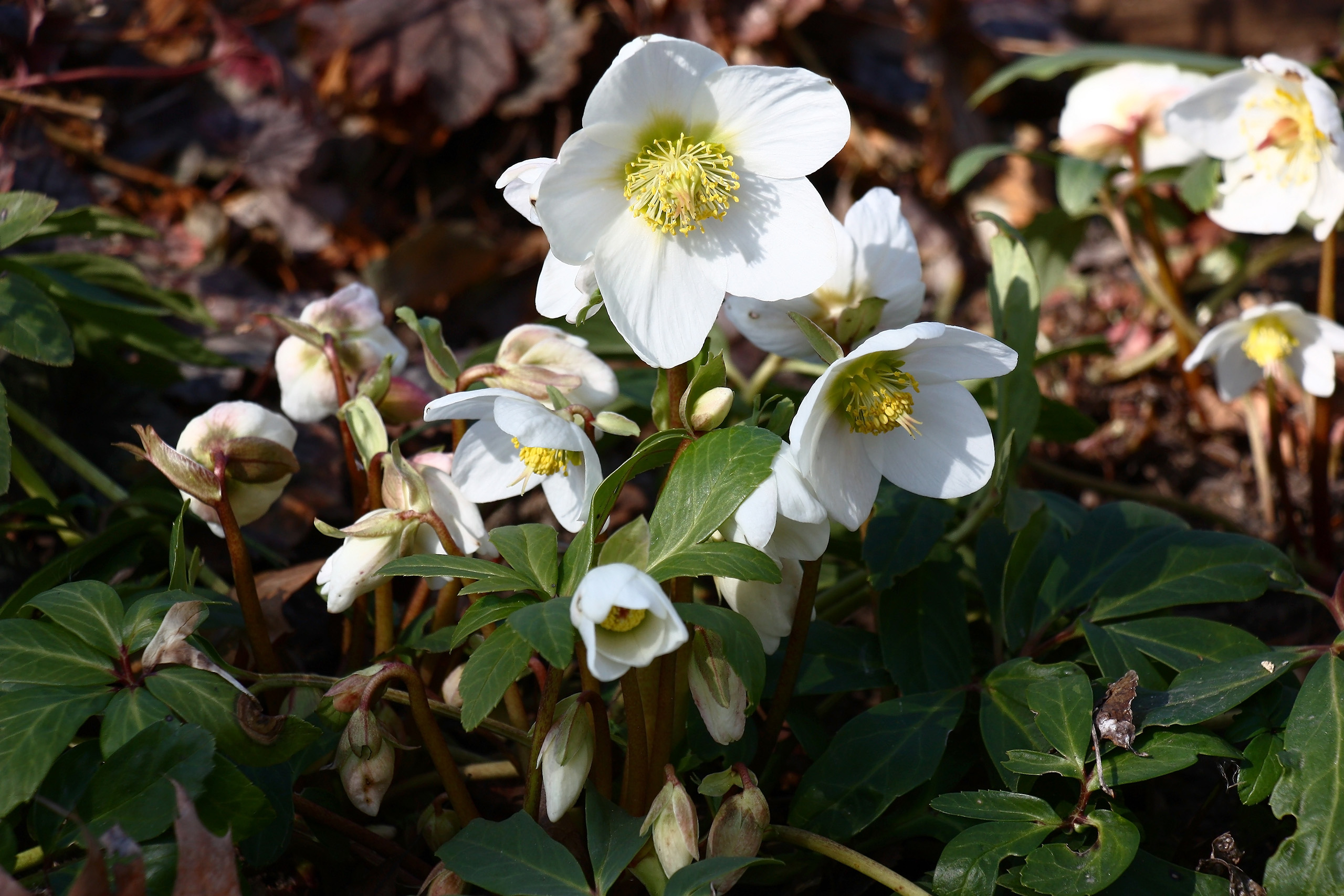
The variety of hellebore can be seen in H. x ericsmithii (a cross between H. sternii and H. niger) planted on Azalea Walk near the Camellia ‘Cornish Snow’. This is a favourite because of its green metallic, white veined leaves and large white flowers, flushed with the palest pink on pink stems, slow to bulk up, and worth the wait.
Elsewhere in the Winter Beds near the Scots Pine and Betula nigra is H. x ballardiae ‘Maestro’, planted on the bank where it receives some sunshine. This semi evergreen plant has white flowers that mature to a dusky pink and is known for its high bud count.
H. sternii ‘Blackthorn Stain’
Champions of the Hellebore – the passion of breeders
Breeding in Germany has continued, and this success can be seen in our Winter Beds. Heuger nursery, Glandorf, has been breeding since the 1950s and The Gold Collection as they are known, are a hardy semi evergreen hellebore producing very large flowers.
Helen Ballard, a British plantswoman who worked in Germany and then began breeding hellebores in Malvern, UK in the 1960s, started with just four plants.
She travelled to see them in the wild, experimenting with a systemized approach in search of clear colour, a good-sized upright flower and vigorous growth.
‘The Hellebore Queen’, as she became known, bred successfully for over thirty years, and her knowledge is saved through research, books and the presence of her plants in gardens.
Elizabeth Strangman was also renowned at that time for her groundbreaking work in breeding spectacular and superbly cultivated H. x hybridus. She aimed for warm rich colours of orange and rich red. The Alpine Garden Society visited her spring garden in Kent in 2019 and she finished the visit with this quote which resonates: ‘A garden is like an autograph book, it is full of connections and experience, it has meaning and inspiration, it is real.’
From the 1980s, and inspired by these breeders, John Massey MBE (Member of the British Empire) VMH (Victoria Medal of Honour), a plant collector, nurseryman and passionate gardener began a programme of seed-raised hellebore breeding at Ashwood Nursery in Staffordshire, working in a range of colours.
This intensive programme resulted in a group known as H. x hybridus (Ashwood Garden Hybrids), and many can be found in The Savill Garden.
2018 was a landmark year for Ashwood Nursery and hellebores because for the first time these plants were displayed at RHS Chelsea in a single exhibit. It was the culmination of painstaking breeding of these single, double and anemone flowers.
H. x hybridus (Ashwood Garden Hybrids). John Massey, VMH
Breeders are in search of stronger, more improved plants, with variety of colour, larger upward facing flowers and variety of flower colour and leaf markings. Breeding takes many years and distinctive qualities from lengthy programmes of crossing can result in expensive plants.
This makes it challenging when choosing the right plant from such large quantities. There are so many varieties to choose from and although these are very tolerant plants, they may not like a particular spot in the garden.
Helleborus x hybridus in The Savill Garden
Some of the Ashwood Garden hybrid hellebores are planted on the edge of the Fernery in The Savill Garden underneath the Acer ‘Sango Kaku’. It is a lovely group which have naturalised over time, and a great example of mixed woodland and ‘Robinson’ planting with early spring bulbs, crocus, snowdrops and so a perfect spot in the sunshine.
‘Robinson’ planting refers to the gardening practices of William Robinson (1838-1898) and the work of Nick Robinson, author of ‘The Planting Design Handbook’. This style of gardening is characterized by dense plantings of perennials and native groundcover in natural-looking drifts.
‘I love the Ashwood Garden hybrids as I find them to be a lovely unassuming group of Hellebores growing at a diminutive height of 20-30cm, in double, single, plain, flushed and spotted shades of white, pink, apricot, yellow, green, purple and near black. They flower for a long period and lend themselves perfectly to mixed woodland planting with spring bulbs.’ Michelle Cleave Supervisor, The Savill Garden
In 2016, exciting new Heuger hybrids were added to The Savill Garden Winter Beds. These are interspecific hybrids bred in Germany, H. x ericsmithii ‘Pink Frost’, H. x ballardiae ‘Camelot’ and H. x nigercors ‘Icebreaker Maxi’ and they have demonstrated exceptional progress in Hellebore breeding.
Away from the Winter Beds, there is a hellebore planting group on the edge of Spring Wood near the sassafras grove. Helleborus ‘Moonshine’ is a stunning pale cream flower fading to dusky coral pink as it develops.
‘I love the ‘supermodel’ appeal of these new hybrids and am always tempted every year by something new, however you must find the right one, as they can sometimes live fast from very long and sustained flowering and die young. Perhaps this may also be due to the subtleties of not liking a particular spot in the garden.’
‘There are more hellebore species and cultivars I am keen to acquire as there is much potential in The Savill Garden for these, with the right plant in the right place.’ Michelle Cleave Supervisor, The Savill Garden
H. x ballardiae ‘Camelot’
Friends of The Savill Garden and Hellebores
Twenty years ago, a former Chair and Friend of The Savill Garden, Janet Callender, shared a botanical drawing of H. niger on the front cover of our Friends winter newsletter. In this article, Friends of The Savill Garden have shared their love of Hellebores.
Barbara and Robbie Sampson have grown hellebores in Ottershaw for 40 years and found them to be easy and reliable. Three types of hellebores grow well in their shady damp garden, most successfully being the H. orientalis.
Barbara’s parents lived very near to Ashwood Nursery, and they have the Ashwood Garden Hybrids. Most years they add plants to the collection.
‘They are such a welcome sight as their nodding flowers last from Christmas to Easter.’
‘These hellebores have seeded quite freely around our garden, so we now have them popping up in many of our beds. Other hellebores that have grown well in our clay soil are H. argutifolius, the holly leaved Corsican hellebore, this again seeds itself around the garden, it is a large plant and needs some support as the lime green flowers persist for a long time in the spring.’
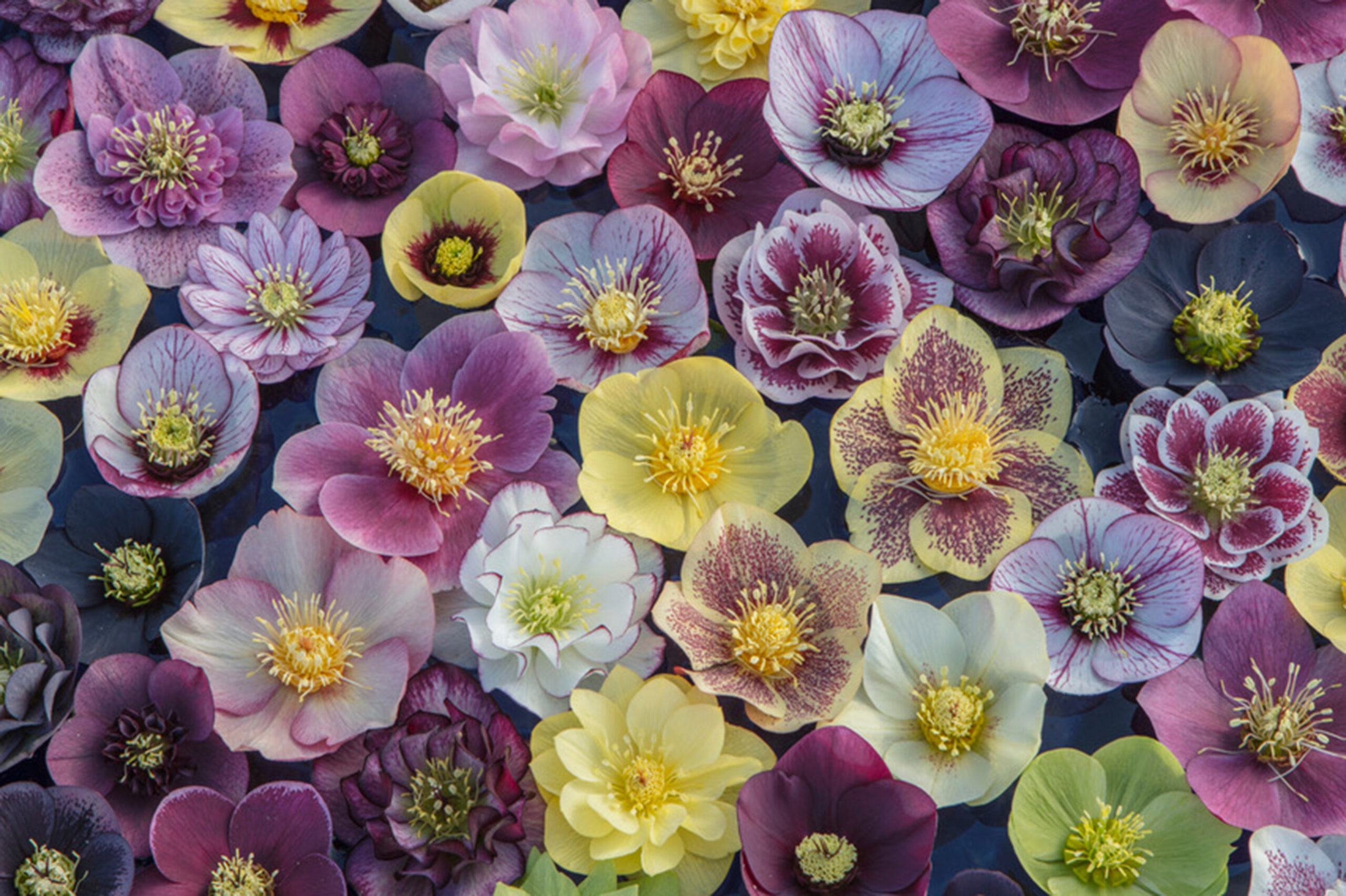
‘For a wilder part of the garden in more shade, H. foetidus the stinking hellebore has also done well. As most flowers face downwards, we always have bowls of water, in the house, with cut hellebore flowers floating and we can admire the detail on those long winter nights.’ Barbara Sampson, Friend of The Savill Garden.
Floating hellebore flowers. John Massey VMH
Julia and Norman Tetchner have more than ten hellebore varieties in their Sunninghill garden of acidic/sandy soil. These varieties do well in sun and shade and seed themselves around the garden.
These varieties include H. lividus ‘Purple Ear’, a clump forming Ashwood Nursery cultivar, and the species H. niger – the white hellebore commonly called ‘Christmas Rose’.
In addition, the Techner’s have several Ashwood Garden hybrids in a variety of colours from pure black to deep purple with frilly sepals, to white and deep pink.
Julia has also planted some of the German breeders Gold Collection H. x ericsmithii ‘Shooting Star’, H. x ericsmithii ‘Winter Song’, H. niger ‘Josef Lamper’ and H. Ice N’ Roses ‘Red’.
Two other species also grow in their garden H. argutifolius, the Corsican hellebore, and H. foetidus, the stinking hellebore, both of which flower until early summer.
‘I think they are one of my favourite flowers and a joy to see in early spring.’
‘Large groups of them grow in our garden very happily, flowering for weeks and hardly need any attention except the cutting of leaves to see the early flowers in November or December.’ Julia Tetchner, Friend of The Savill Garden.
Choosing Hellebores
There are a wide variety of hellebores to choose from. Most are hardy in the UK and the flower colour is wide and can be challenging to predict from seed raising. They are a plant that is hard not to love and have flowers to brighten the gloomy days of winter. From pure white to the wide variety of the H. x hybridus, there is something for every garden.
In The Savill Garden we are blessed with an abundance of them, and we look forward to seeing them flower over the coming weeks in the garden.
Written by Michelle Cleave, Supervisor for The Savill Garden & Sian Thomas, Friend and Guide of The Savill Garden. Thanks to Barbara Sampson, Liz Howell and Julia Tetchner, Friends of The Savill Garden for their input.