When the Friends were formed its aims were:
‘To create and sustain an enjoyable social group for those who have an appreciation for all gardens and especially The Garden. When possible, through various activities and projects, to generate funds to support the Keeper of the Gardens to continue to enhance the Garden.’
40 years later we continue to keep to those aims including to provide items for the Garden. The funds raised for such items, mainly come from two sources: any profits from events, and the fees earned for us by the Friends Guides when they take tours around the Garden. We also receive donations and as you will read, there has also been the occasional appeal.
The Great Storm
Many of us will remember the night of 15 – 16 October 1987, when what became known as the great storm hit the UK in the morning of 16 October 1987.
The storm made landfall in Cornwall, and tracked north-east towards Devon and then over the Midlands, going out to sea via The Wash. The highest wind speed recorded on land was 115mph and gusts over 90mph were quite common; 18 people lost their lives, and 15 million trees were destroyed or damaged.
Following the storm Ted Green, the then Conservation Advisor for Windsor Great Park, recorded those loses on a map of Windsor Great Park. Oak trees lost had a red dot, beech a blue circle, sweet chestnut a green triangle and so on.
In his recently published book ‘Treetime’ he noted that the single species plantations were more severely affected than mixed ones. He also noted that none of the veteran oaks had been lost, speculating that their hollow trunks may have helped preserve them.
Friends committee minutes: 6 November 1987
The Friends were quick to respond and in the minutes of the committee meeting held on 6 November 1987 it was recorded that:
John Bond was invited by the Chairman to say a few words. John’s talk was dominated by the October gale disaster giving details of the damage suffered, the initial work already undertaken and the vast amount of work that will have to be done in the weeks, months and even years to come. He also spoke of other great gardens that have suffered even worse damage, especially those in Sussex some of which were visited by the society recently.
John expressed his regret at having to cancel our Day Meeting in October but thanked those Friends who had attended a recent Saturday “Work Day” and praised the amount of clearing up they had achieved in the Arboretum. He proposed another such Working Day in the near future and hoped that the weather would be kinder than on that occasion.
John also spoke of the need to get back to the proper, more normal, work of gardening. They still hoped to open the new shop on 1 April and the Ha-Ha had to be cleaned up and planted by then. He also touched on the possibility of the old shop being turned into the New Zealand garden with the plants being a gift from New Zealand to the Queen. It was hoped that this would be ready to open in May or June.
After thanking John for talking about the storm damage the Chair spoke of the pleasure of the Friends helping – if only in a small way and hoped that more Working Parties would be held.
With the grave matter of the storm damage still in mind the secretary put a suggestion to the meeting – that the Friends now had an opportunity to really show the meaning of “Friendship” and proposed that an appeal be launched to all the members to replace trees in a definite area.
The Arboretum would appear to be an appropriate place since this was the area that the Friends were working in and perhaps, in due course, a small plaque could be put there to show that the Arboretum was cleared and restored after the 1987 storm by the Friends of The Savill Garden. It was agreed that the Chair and Secretary would launch the appeal by special letter.’
The Friends’ Grove
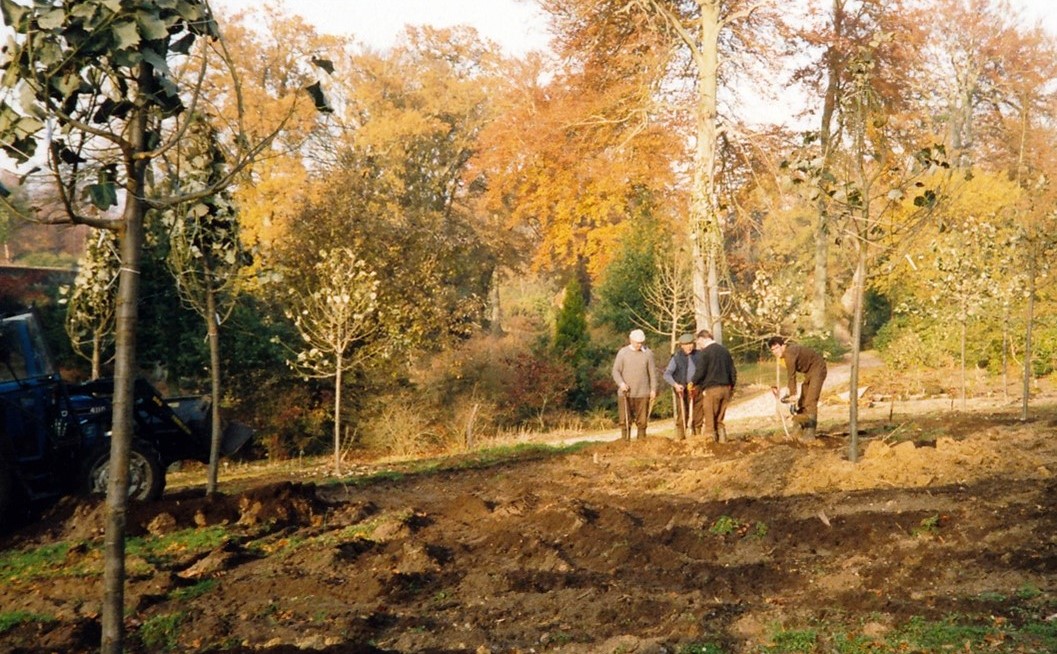
After a lot of clearing had been completed the new grove of trees started to be planted in 1988 and it was called the Friends Grove.
As you can see much of the planting was done by shovelling the earth and it was quite a laborious task, but a grove of Tilia Tomentosa was planted and was well established by the following year. The Friends donated £142 towards the new trees.
Planting for the Friends’ Grove in 1988
A plaque was erected to commemorate the event in the presence of John Bond.
The plaque is no longer there, but I’m pleased to say the trees are still flourishing.
The Summer House
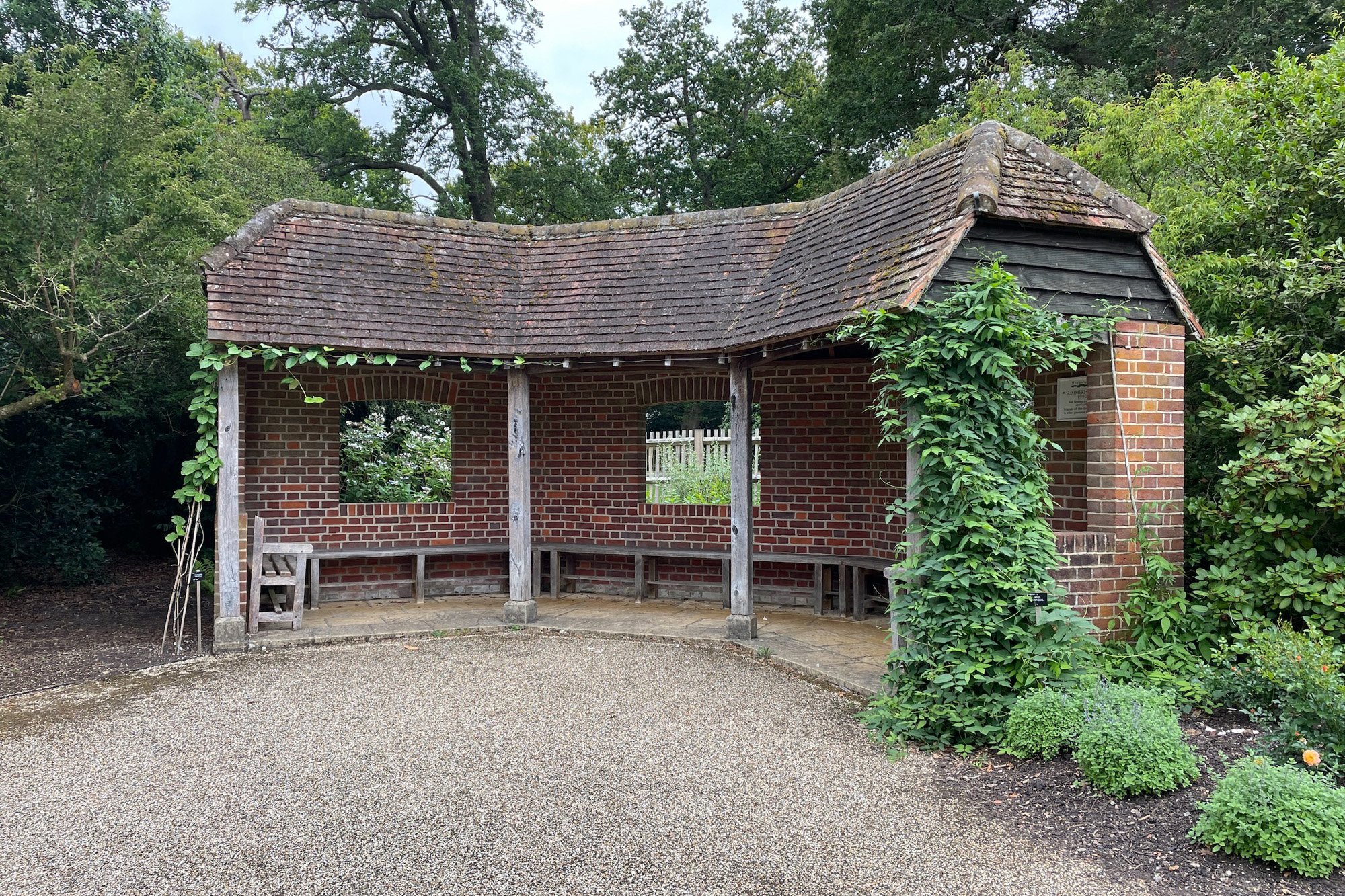
At the far end of the Garden, opposite the magnificent Eric Savill magnolia is the Summer House, an excellent spot in which to take a small rest and enjoy the view back over the Garden.
The Summer House was the idea of the then Keeper of the Gardens John Bond as the then Chair of the Friends reported to the Friends at the AGM in 1990 in this extract from the minutes:
‘The Chair told the meeting of John Bond’s desire to replace the existing garden shelter in the hydrangea corner. It is one of the aims of The Friends to provide amenities for the garden and to this end it has been decided to launch an appeal to all members.
The committee would start off by donating £500.00 from existing funds and a further £1000.00 has already been donated by a retiring member of the Crown Estate staff.
John Bond spoke of summer planting, particularly in the area where the garden shelter is, as this area had suffered badly from the storms, especially from the loss of the huge turkey oak. It was hoped with a more attractive Summer House and summer planting this would provide a more attractive area at the end of the garden.’
At the following AGM we read that:
John Bond reported that work had started. The shelter would have a brick base, timber above and a tiled roof. There was a small shortfall between the amount of money available and the cost of the shelter, but this would present no difficulty. The major part of the building cost had been supplied by The Friends for which he expressed his gratitude.
Also, at that AGM the balance sheets showed that the Summer House Appeal was standing at £3143.00.
The following year the Friends transferred £3,500 to the Crown Estate with a smaller amount of £375 donated the following year.
Considering that £1 in 1990 would be worth about £2.41 today that was an incredible achievement on behalf of the Friends.
The Summer House was officially opened in 1992 and the Friends placed a plaque there to commemorate the event and their part in the building.
When I joined the Friends committee, one of the topics of conversation was the replacement of the Summer House, which at the time was seldom used as it was difficult to access.
Then the extra paths were put in and one could finally get to it without getting one’s feet wet, I for one am very pleased it’s still there.
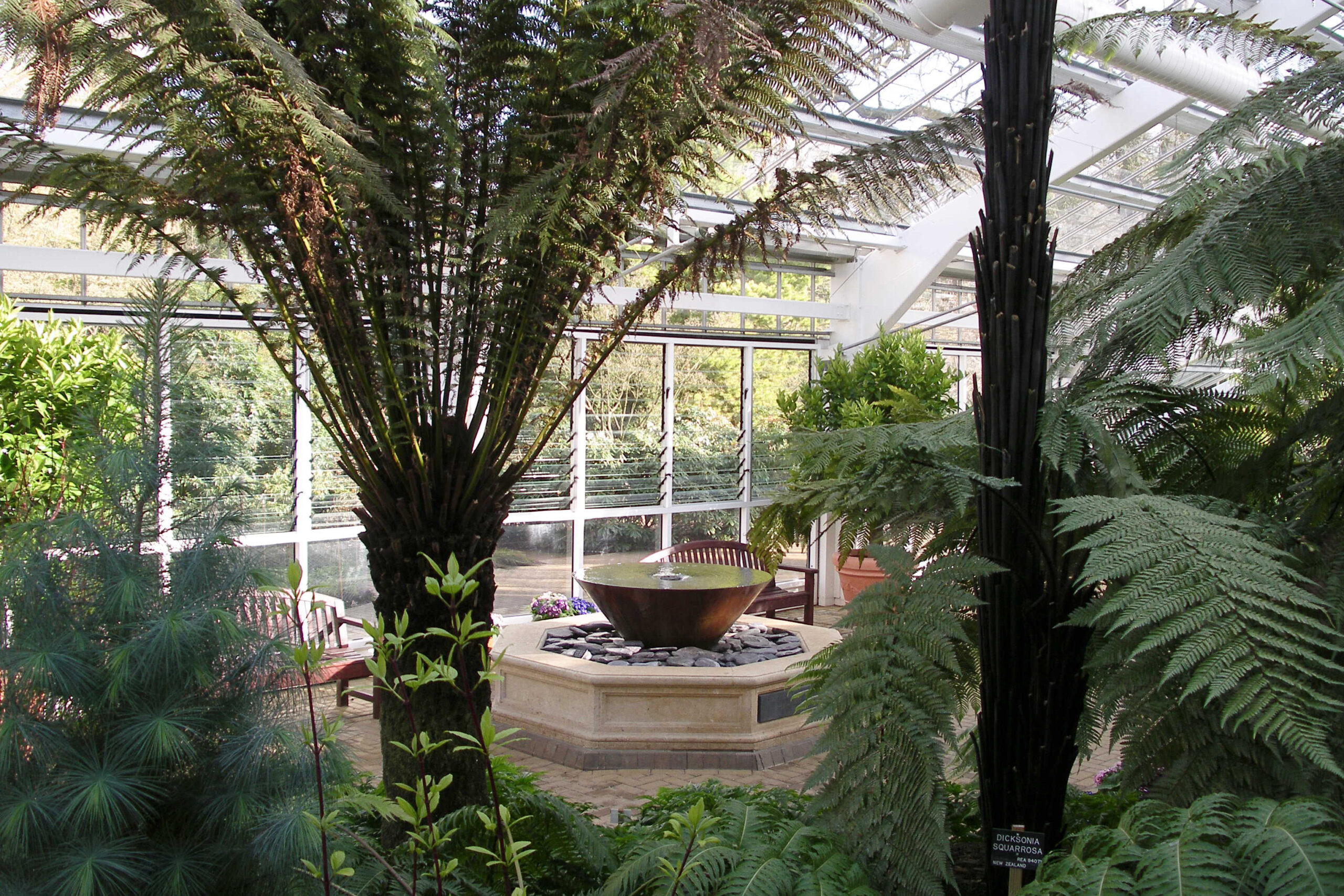
The water feature in the Queen Elizabeth Temperate House
The Queen Elizabeth Temperate House was officially opened by Queen Elizabeth II on 25 April 1995. The building stage was completed in April 1994, followed by the fitting out of the interior during the rest of that year.
The minutes of the Friends AGM of 11 November 1994 has a mention of £520.00 raised at a luncheon for the funding of the water feature in the new Temperate House, while the Treasurers report showed uncommitted funds of £3848.89.
This allowed £3200 to be provided towards the water feature.
On the same occasion John Bond reported that the soil had been placed in the Temperate House and planting would start soon. The water feature, so generously funded by The Friends was not quite finished but would eventually be a fine addition to the Temperate House.
Although not a Friends event, the opening of the Temperate House (and the water feature provided by The Friends) by Queen Elizabeth II was watched by a large gathering of Members – three of whom were privileged to represent The Friends on this occasion.
At the following AGM John Bond reported that the Temperate House was proving a great success with the plants growing well.
At the AGM in 1996 John Bond’s report showed that The Temperate House had that day received an award from RIBA (Royal Institute of British Architects).
The original water feature consisted of the hexagonal base, with the plaque commemorating the opening of the Temperate House, on top was a fountain feature. The Charybdis water feature was added in 2006.
Charybdis inside the Queen Elizabeth Temperate House
The quincunx of Fagus Sylvatica ‘Dawyck Gold’
John Bond was the Keeper of the Gardens from 1970 until 1997 when he retired.
More importantly for us he started the Friends of the Savill Garden and so fittingly the committee decided to mark the event of his retirement by planting a living memorial in The Savill Garden.
It was announced at the 1996 AGM that:
‘This will take the form of quincunx of Fagus Sylvatica “Dawyck Gold”, arranged in the shape of a rectangle or square with one at each corner and one in the centre.
‘John Bond has already chosen the trees personally from Hilliers and preparation for planting in an area northwest of the Summer House is already under way. A suitable plaque will be prepared, and this will be unveiled by John during the spring Day Meeting on 6 April 1997.’
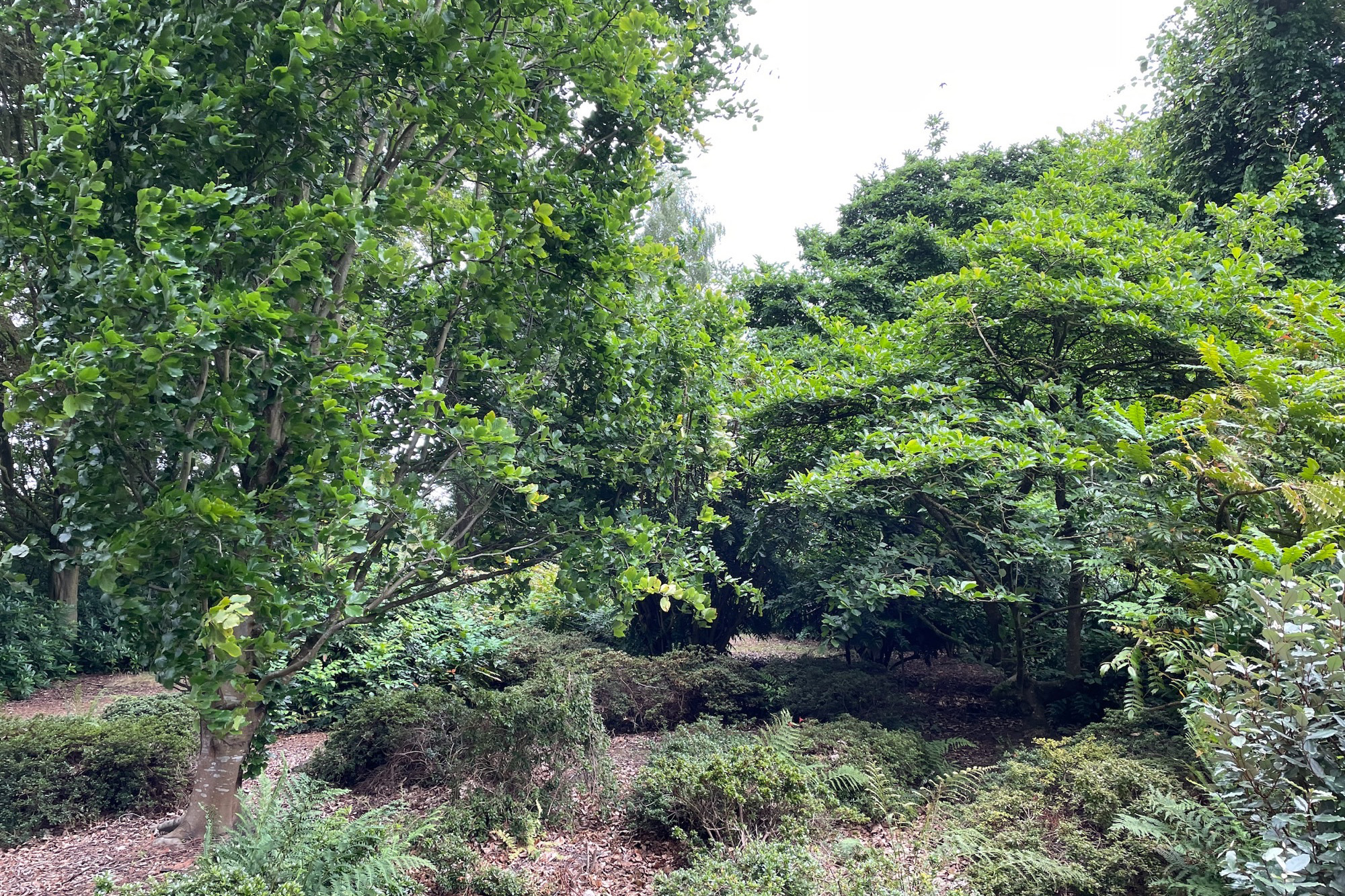
Sadly, there is now just one of these remaining. There were three trees for many years but in 2023 two more had to be taken down and the plaque has also been removed.
The remaining Beech tree in The Savill Garden
This article is dedicated to our current Friends of The Savill Garden Secretary Jackie Dudley, without whose careful research this article would have been very much shorter and less interesting and to all her predecessors who wrote such detailed minutes.
Thanks are also due to David Eno for many of the photos.
With an article related to funds raised by the Friends, this is an opportune moment to say that later this year we will also be saying goodbye to our Treasurer, Barbara Sampson.
Written by Diana Bendall, Chair, The Friends of The Savill Garden